Solutions
Airport car service for business travelers, planned around the flight
We coordinate airport pickups and drop-offs for business travelers at airports across the US. The pickup is tied to the actual flight, with a defined meeting point and a plan for delays.
Updated
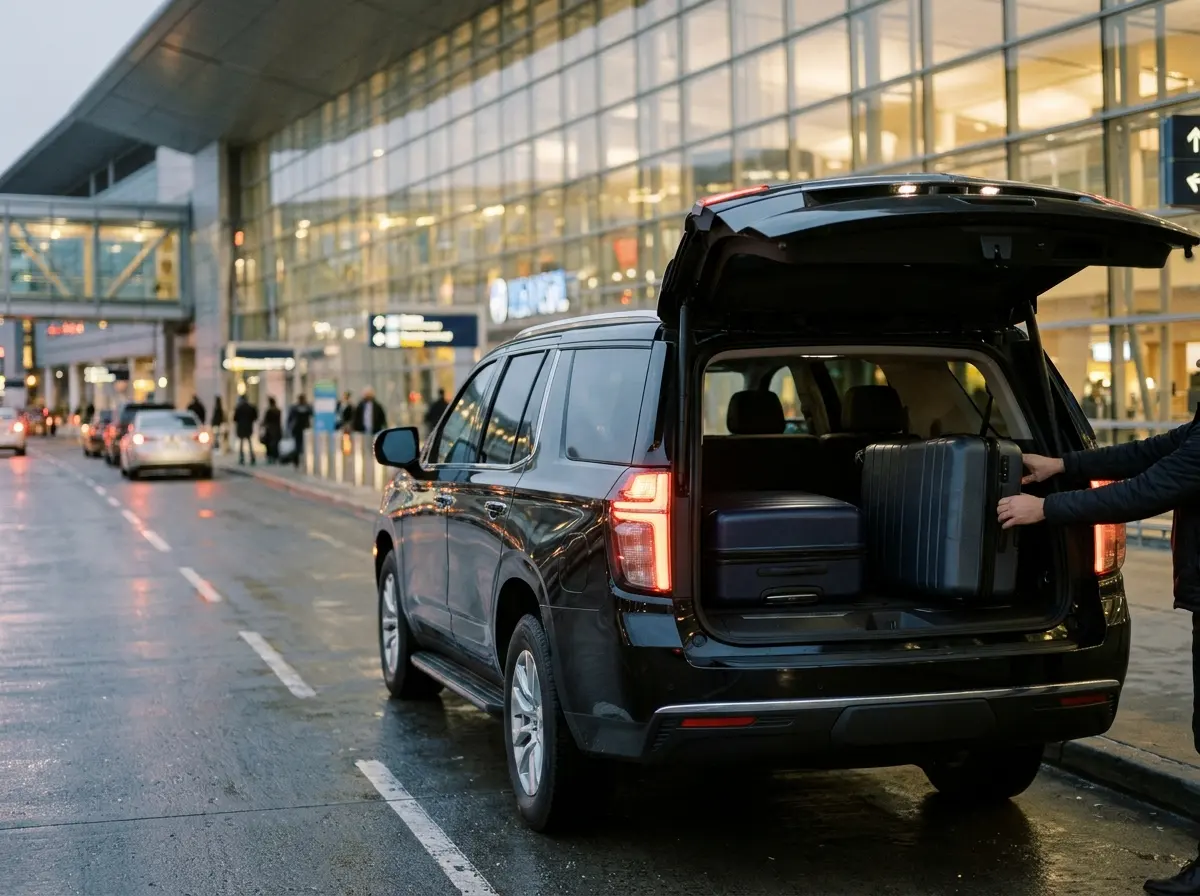 Illustrative image
Quick answer
Airport car service for business travel is a pre-booked, professionally driven pickup or drop-off tied to the traveler's actual flight, with a defined meeting point and a plan for delays. Corporate Travel USA coordinates corporate airport transfers at airports across the US through owned operations or vetted local partners, confirmed per airport at proposal stage. Pricing is by proposal, with airport fees shown in the quote.
How it works
How corporate airport transfers work
The airport is where a corporate trip most often goes wrong. A flight lands early, the passenger cannot find the driver, the terminal has three arrival doors, or a delayed connection leaves a car idling for an hour. Good airport service is mostly about removing those small uncertainties before the trip.
For each transfer we capture the flight number, terminal where known, passenger count and luggage, and the destination. The assigned driver monitors the flight and adjusts the pickup to the actual arrival. Meeting instructions depend on the airport: some use curbside meet, others require the driver to wait inside or in a designated lot.
Service at each airport is delivered by owned operations or qualified local partners, confirmed at proposal stage. Airport rules differ on commercial vehicle access, wait times and fees, and we plan around them rather than assume them.
This page covers individual and small-party business transfers. Large arrivals for a conference or meeting are handled as group airport transfers, and standing weekly patterns are scoped as recurring airport transfers.
Airport car service: where it fits
Visiting client or candidate
A guest arrives for a one-day meeting. The driver holds a name sign, handles luggage and gets them to the office with time to spare.
Employees returning from trips
Pickups timed to the flight, so people landing late at night are not left arranging their own way home.
Executives on tight connections
Home or office to departures with a buffer set to the airline, terminal and time of day, rather than a generic rule.
Small teams arriving together
Four to eight colleagues landing on one flight, met in an SUV or Sprinter-class van with luggage space planned.
Multi-airport itineraries
A traveler arriving at one airport and leaving from another, with each leg confirmed with a local operator in each city.
What we plan for in airport car service
The vehicle is the easy part. These are the operational details that decide whether the program runs on time.
- 01
Flight details and tracking
We ask for the flight number rather than an arrival time. Arrival times change; the flight is what the driver follows.
- 02
Meeting point
Choose between curbside meet, baggage claim meet and greeter service where the airport permits. The right choice depends on the traveler, not just the airport.
- 03
Wait time policies
Operators typically include a defined grace period after landing, and longer for international arrivals. We confirm the policy for your airport in the proposal.
- 04
Luggage and passenger count
Two travelers with full checked luggage often need more than a sedan. State the bags, and we match the vehicle.
- 05
Delays and cancellations
Agree how a cancelled or rebooked flight is handled, and who at your company can approve the change.
How far ahead should you book an airport car service?
Book an airport car service as soon as the flight is ticketed. The requests that need the most notice are larger vehicles, smaller airports, very early or late-night times, holidays and dates when a major event is in town. Corporate Travel USA can start from a partial itinerary: send the flight when it exists and add passenger details later.
Booking early does more than secure a car. It leaves time to arrange the details that are hard to add at the last minute: an inside meet where the airport allows it, a vehicle with room for oversized luggage or equipment, a wheelchair-accessible vehicle, or a driver briefed for a first-time visitor. It also gives your approver time to review the quote instead of accepting whatever is left.
If the flight changes after booking, send the new flight number rather than a new time. The booking stays the same; only the flight it follows changes.
- Vehicle size: an SUV or Sprinter-class van is harder to find at short notice than a sedan.
- Airport size: smaller airports often have fewer operators to draw on.
- Time of day: very early departures and late-night arrivals narrow the options.
- Dates: holidays, conventions and major sporting events tighten supply across a whole metro.
- Special requirements: accessible vehicles, child seats or extra luggage space have to be sourced specifically.
What happens when a flight is delayed?
When a flight is delayed, the pickup moves with it: the driver follows the flight's actual arrival rather than the time on the booking, so no new request is needed for an ordinary delay. What can change is cost, which depends on the operator's grace period and waiting terms, and Corporate Travel USA states those terms in the proposal before the trip.
Cancellations and rebookings are different, because the original flight no longer exists. Send the new flight number as soon as the traveler has it, and say whether the destination or the passenger count has changed.
For tight onward plans, look at the route's track record before setting the buffer. The Bureau of Transportation Statistics publishes on-time performance and delay-cause data for domestic flights operated by large US carriers, searchable by airline, airport and date range. A route that often runs late is a reason to move the first meeting, not to hope for the best.
| Situation | What happens to the pickup | What the traveler or booker should do |
|---|---|---|
| Delayed flight | Pickup moves to the actual arrival; waiting terms apply after the grace period | Nothing, provided the flight number on the booking is right |
| Early arrival | Driver positions as early as the airport allows; a short wait is possible | Message the day-of contact on landing |
| Cancelled flight | Original pickup is cancelled or moved under the operator's policy | Send the rebooked flight as soon as it is known |
| Rebooked to another airport | Treated as a new pickup, possibly with a different operator | Send the new airport and flight, and confirm the destination |
| Overnight misconnect | Pickup moves to the next day; a hotel transfer can be added | Tell us where the traveler is staying |
Curbside vs meet-and-greet pickup: which to choose?
Choose curbside pickup for experienced travelers with carry-on bags who want the fastest exit, and meet-and-greet, where the driver waits inside with a name sign, for first-time visitors, senior guests, travelers with checked luggage and international arrivals. Whether either option is available, and exactly where, is set by each airport, so Corporate Travel USA confirms the arrangement per airport.
Airport rules can be specific. At Seattle-Tacoma International Airport, for example, the Port of Seattle requires prearranged limousine operators to hold a current agreement and permits, provides no staging area for them on airport premises, and requires meet-and-greet drivers to park in designated limo stalls on the third floor of the parking garage and check in at the Ground Transportation booth before loading passengers. Other airports work differently, which is why the meeting point is confirmed rather than assumed.
Whichever you choose, send the traveler the meeting instructions before they fly: where to go, what the sign will say, and who to message if they cannot find the driver.
| Factor | Curbside | Meet-and-greet |
|---|---|---|
| Best for | Frequent travelers with carry-on bags | First-time visitors, senior guests, checked luggage |
| Where the driver waits | Nearby, until the traveler is at the curb | Inside the terminal, where the airport allows |
| Traveler effort | Walks out and meets the car after a message | Is met and walked to the vehicle |
| Usually adds | Little beyond the base trip | Parking and driver time inside, quoted in advance |
Related:Client and guest transportation
Airport limo service or executive airport transfer: which vehicle fits?
For most business trips, an executive airport transfer in a sedan, SUV or Sprinter-class van fits better than a stretch limousine: it is easier to stage at a busy curb, carries luggage better and suits a working arrival. The phrase airport limo service is often used for any chauffeured car, so the real decision is which vehicle class fits the passengers and their bags.
Size the vehicle by luggage first, then seats. Two travelers with full checked bags can outgrow a sedan. A small team with equipment cases may need a van even though the seat count says SUV. The fits below are typical and vary by vehicle and configuration; the actual vehicle for your airport is confirmed in the proposal.
| Party | Typical fit | Watch for |
|---|---|---|
| 1-2 travelers, carry-on or one checked bag each | Executive or luxury sedan | A third passenger or bulky bags |
| 2-4 travelers with checked luggage | Executive SUV | Using the third row reduces luggage space |
| 5-6 travelers with light bags | Larger SUV class | Full checked luggage usually needs a van |
| 7-14 travelers | Sprinter-class van, by configuration | Seat counts drop in premium layouts |
| Larger groups | Minibus or coach, planned as a group transfer | Batch arrivals by flight time |
Related:Executive sedansExecutive SUVsExecutive Sprinter vans
Setting up an airport transportation service for company travelers
A company airport transportation service works best when every booking carries the same core details and follows the same rules: flight number, passenger name and mobile number, meeting preference, destination, approver and billing reference, plus agreed policies on waiting, cancellations and late-night arrivals. Corporate Travel USA scopes these once, so each new transfer starts from an agreed standard rather than a blank form.
Most problems at the airport trace back to a missing detail in the request. The checklist below is what we ask for on each transfer. For travelers who fly the same routes often, a standing pattern can be scoped as recurring airport transfers instead.
- Traveler name as it should appear on the sign, and a mobile number for the day
- Airline and flight number (not just the arrival time), plus the terminal if known
- Passenger count and luggage, including anything oversized
- Meeting preference: curbside or meet-and-greet
- Destination address and any building access instructions
- Approver for changes, and the PO or cost-centre reference
- Any company rules for late-night arrivals, for example a drop-off confirmation to the booker
Vehicle categories
Vehicles for airport car service
Categories, not guarantees. Availability varies by market and is confirmed in your proposal.
Executive Sedans
Typically 1-3 passengers
Chauffeured business-class sedans for individual executives and small teams on airport, meeting and city-to-city runs.
Executive SUVs
Typically 1-6 passengers depending on SUV class and luggage
Chauffeured business SUVs for small teams, extra luggage and travelers who want more space.
Executive Sprinter Vans
Typically 9-14 passengers depending on configuration
Chauffeured Sprinter-class vans that keep a mid-size team together on airport runs, offsites and meeting days.
Luxury Sedans
Typically 1-3 passengers
A higher vehicle category, always chauffeured, for senior executives, board members and VIP guests where presentation matters.
Minibuses
Roughly 20-35 passengers depending on vehicle type and layout
Chauffeured minibuses for groups of roughly 20-35: conference loops, offsites, employee routes and airport groups.
How to book an airport car service
- 1
Send the flight details
Passenger names, flights, airports, destinations and luggage. If the traveler is not known yet, send what you have and update it.
- 2
Confirm airport and operator
We identify the operator at each airport and confirm meeting arrangements and vehicle class.
- 3
Proposal and driver brief
You approve the proposal. The driver receives the passenger details, flight and meeting instructions.
- 4
Track and adjust
The driver follows the flight, and we stay reachable for changes until the traveler is delivered.
Airport car service: procurement and billing
- Pricing is by proposal. Airport fees and parking charges are addressed in the quote rather than added later.
- Cost-centre or PO references can be attached to each transfer; reporting is scoped per program.
- Insurance certificates available on request for the operator in each market.
- Where volume is regular, a consolidated billing arrangement can be scoped.
Airport car service FAQs
Do you track flights?
The assigned driver or operator tracks the flight so the pickup follows the actual arrival. Tracking method varies by operator and is confirmed per market.
What if the flight is delayed or cancelled?
A delay needs no action if the flight number is right: the pickup follows the actual arrival. For a cancellation or rebooking, send the new flight as soon as you have it. Changes are handled under the operator's policy, which is explained in the proposal, so do not assume a cancellation is free before you see it in writing.
Can the driver meet someone inside the terminal?
It depends on the airport. Some allow inside meet-and-greet, others restrict where drivers can wait or park. We confirm the rule for your airport before the trip.
Can we book transfers for a team landing at different times?
Yes. Each arrival can be planned separately, or combined where the times are close. For larger groups, see group airport transfers.
Is this the same as recurring airport service?
No. This page covers booked transfers. If you need the same route on a regular pattern, we scope recurring airport transfers.
How are airport fees and parking handled?
They are addressed in the quote rather than added afterwards. Airports set their own permit rules and fees for commercial vehicles, and meet-and-greet usually adds parking and driver time, so ask for each item to be shown separately.
What if the traveler cannot find the driver?
The traveler contacts the driver or the day-of contact using the details sent before the flight. That is why the meeting instructions, including what the sign says and where the driver will wait, go to the traveler before departure, not after landing.
Can one booking cover the outbound and return flights?
Yes. Send both flights together and we plan both legs, each tied to its own flight number. If the return is not booked yet, the outbound can be confirmed now and the return added later.
Sources and references
- Pre-Arranged Limousines Requirements (Seattle-Tacoma International Airport), Port of Seattle
- Airline On-Time Performance: Delay Causes, Bureau of Transportation Statistics, US Department of Transportation
Next step
Get a quote for this trip
Share the itinerary and we will come back with a quote. Two short steps.
We do not publish a response-time promise until it is operationally confirmed. Time-sensitive request? Say so in the notes.
Start your request
Related airport and travel services
- Recurring Airport TransfersPlanned, repeating airport transportation for executives, visiting staff and regular business travelers.
- Group Airport TransfersArrival-wave management for groups: flight tracking, staging, meet-and-greet and timed departures to the venue.
- Private Aviation TransfersPrivate jet car service to and from FBOs and private terminals, planned around ramp access, flexible timing and passenger privacy.
- Executive Chauffeur ServiceProfessional chauffeured transportation for executives, coordinated nationwide and confirmed market by market at proposal stage.
- Resources group airport transfer planning
- Fleet executive suvs