Group category · Roughly 47-56 passengers per full-size coach
Charter Bus Rental for Large Corporate Groups, Driver Included
Corporate charter bus rental always comes with a professional, properly licensed driver. You tell us the headcount, the schedule and the stops; we plan the coaches, the timing and the loading points, and quote the itinerary.
Updated
 Illustrative image
Quick answer
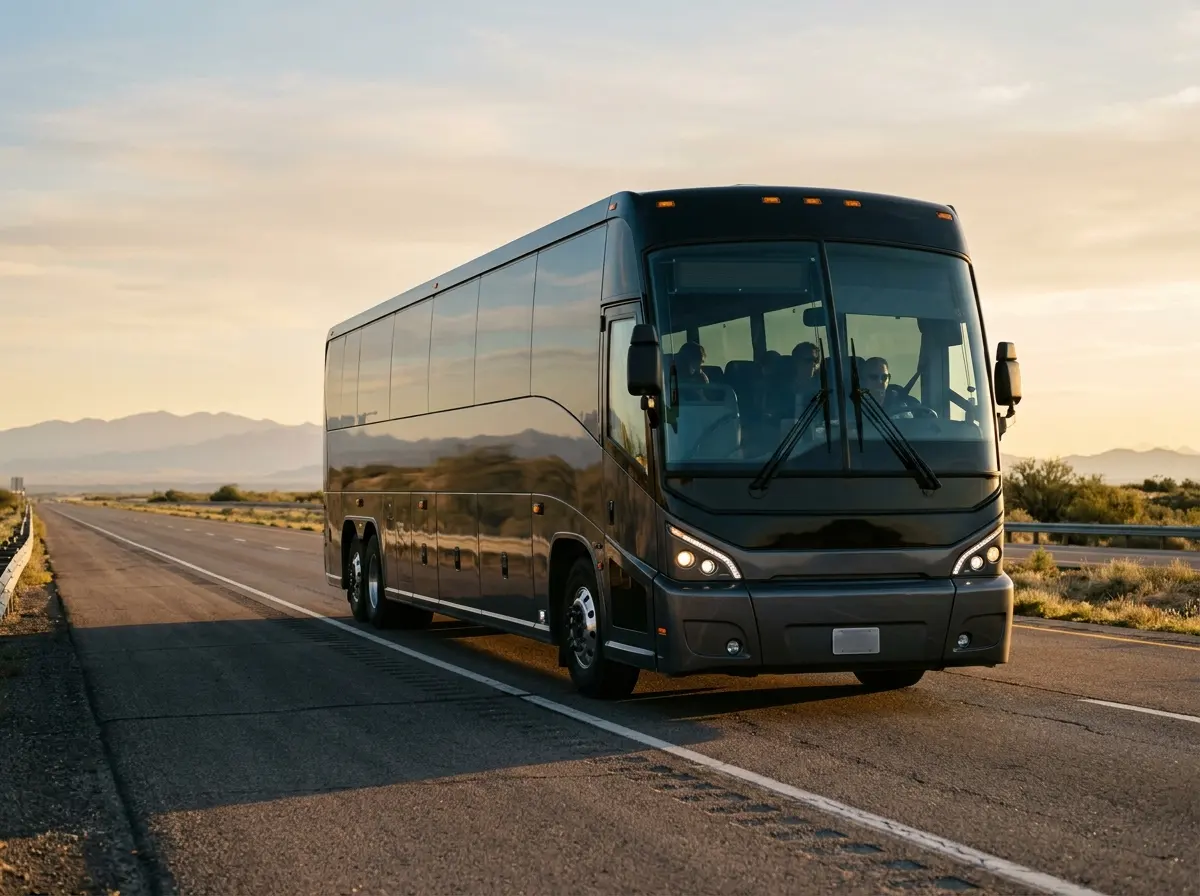
Charter bus rental for corporate groups means booking a full-size motorcoach, typically 47-56 seats, with a professional CDL driver included, for conferences, offsites, airport waves and multi-city trips. Corporate Travel USA coordinates coaches nationally through owned operations or vetted local partners, confirmed per market, plans the schedule and loading points, and prices each itinerary by written quote. Self-drive bus rental is not offered.
A full-size motorcoach typically seats around 47 to 56 passengers, with large under-floor luggage bays beneath a raised passenger deck. "Charter bus", "coach bus" and "motorcoach" usually describe the same vehicle. Larger programs use several coaches, with the count planned from headcount, timing and venue limits rather than seats alone.
Every coach Corporate Travel USA coordinates comes with a professional driver supplied by the operating carrier. For a vehicle this size, that is the only sensible way to book: driving it requires a commercial license with a passenger endorsement, and the operator carries the safety, maintenance and driver-hours obligations.
Coach logistics differ from car logistics. Driver hours, loading zones, turning space and parking restrictions all shape the plan. A motorcoach cannot always pull into a hotel driveway, so venue coordination is part of the work, not an afterthought.
Coach bus rental for conferences, offsites and multi-city trips
Conference and convention transfers
Coaches move attendees between airport, hotels and venues in volume. A timed schedule and clear loading points reduce queues.
Off-site events and galas
One departure from a hotel to a venue gets everyone there together, with a return plan that accounts for late finishes.
Group airport waves
When a large group lands within a short window, coaches with under-floor bays carry people and checked bags in one movement. Staggered arrivals may suit smaller vehicles better.
Workforce and site transport
Fixed routes serving large facilities or temporary sites can be run with coaches. Our workforce transportation pages explain how these programs are scoped.
Multi-city group travel
Roadshows and group tours that include longer distances use coaches with attention to driver hours and rest breaks.
Motorcoach rental limits: drivers, access, luggage and accessibility
Loading zones and access
Confirm where coaches can stop, wait and turn. Many city venues have restrictions that shape the schedule.
Driver hours
Federal hours-of-service rules limit how long one driver can drive and stay on duty. Long days may need a second driver, a split shift or an overnight stop, and the proposal states the plan.
Plan for no-shows and extras
Real attendance rarely matches the registration list. Build in a margin for coaches and a plan for standby vehicles where it matters.
Accessibility
Lift-equipped coaches can be arranged; request them early. Under the DOT's ADA rules for over-the-road buses, charter operators may require up to 48 hours' notice to provide an accessible coach.
Can you rent a bus without a driver?
Not through Corporate Travel USA: every charter bus booking includes a professional driver supplied by the operating carrier. For a full-size coach, FMCSA requires a commercial driver's license (CDL) with a passenger endorsement to drive any vehicle designed to transport 16 or more passengers, including the driver.
The license is only part of it. FMCSA's guidance for organizations that run their own buses lists what comes with operating one: a drug and alcohol testing program for CDL drivers, qualification standards for drivers who cross state lines, limits on consecutive driving hours, and systematic inspection, repair and maintenance of the vehicle. An organization whose own staff drive its bus for group outings is treated as the operator and takes on those obligations.
Chartering moves those responsibilities to a carrier whose business is running coaches. Your team plans the event; the operator supplies a qualified driver, a maintained vehicle and compliance with driver-hours rules; and we coordinate the schedule between them.
- A driver qualified for the vehicle class, supplied by the operating carrier
- Pre-trip inspection and maintenance handled by the operator
- Driver-hours planning, including relief drivers on long days when needed
- Routing, staging and loading points agreed before the day
Related:Our transportation standardsLarge group transportation
How much does a charter bus rental cost?
Charter bus rental cost depends on the itinerary, so Corporate Travel USA prices it by written quote rather than a published rate. The biggest drivers are billed hours, distance including empty repositioning miles (deadhead), the number of days, driver rest requirements and the dates you need.
Two itineraries with the same headcount can price very differently. A four-hour local transfer and a 14-hour day with a dinner return use the same coach but not the same driver time, and a trip that would push a driver past federal hours-of-service limits needs a second driver or an overnight stop. For passenger-carrying drivers in interstate commerce, FMCSA limits driving to 10 hours after 8 consecutive hours off duty and bars driving after 15 hours on duty.
The quote states which items are included and which are billed as incurred, so finance can compare like with like. The table shows what moves the number and what to send so the quote is accurate the first time.
| Cost driver | Why it matters | What to send us |
|---|---|---|
| Billed hours | Many operators bill from when the coach leaves its base until it returns, and apply a minimum booking length. | Exact first pickup and final drop-off times |
| Distance and deadhead | Empty miles to the first pickup and back after the last drop-off are part of the job. | Every pickup and drop-off address |
| Multi-day trips | Overnight programs commonly add driver lodging and may hold the coach on days it does not move. | Day-by-day schedule and hotel locations |
| Driver rest rules | Long days or long distances can require a relief driver or an overnight stop. | The total span of each day, not just driving time |
| Peak dates | Convention weeks, holiday weekends and graduation season tighten coach supply in many cities. | Dates, plus any flexibility |
| Extras | Tolls, parking, permits, driver gratuity and wait time are handled differently by different operators. | Ask for each one to be listed |
Related:Corporate ground transportation budgetingGet a quote
How to charter a bus for a corporate group
To charter a bus for a corporate group, send a dated itinerary with headcount, every stop and the luggage profile, then confirm the proposed coach count, loading points and contacts in writing. Corporate Travel USA turns that brief into a coach plan for each market and quotes it before anything is booked.
The most common gap in a charter request is the schedule. "Conference transfers on the 14th" cannot be quoted accurately; "five departures from two hotels between 7:00 and 8:15, returns from 17:30" can. The second version also tells the operator how many coaches must be on site at once and how many can cycle.
Illustrative example, not a quote: 140 attendees at two hotels, one venue 25 minutes away. At 56 seats per coach, 140 people need three coach loads. If both hotels must load at the same time, plan three coaches on site; if departures can be staggered by about an hour, two coaches can carry the first wave and one returns for the rest, which saves a vehicle but adds risk if traffic runs heavy.
- Dates, and the first pickup and last drop-off time for each day
- Headcount per movement, plus the realistic no-show and late-addition range
- Every address, with loading-zone notes from each hotel or venue
- Luggage per person, and any equipment, display or oversized items
- Accessibility needs, as early as possible
- On-site contact names and how changes will be approved
- Billing reference, PO or cost center to show on the invoice
Related:Corporate event transportation planning guideRequest a proposal
56 passenger bus rental: how many coaches does your group need?
Divide your headcount by the confirmed seat count of the coach, round up, then add margin for staff, late additions and luggage. A 56 passenger bus rental and a 47-seat coach both count as full-size, so the exact seat count in your market changes the answer.
Seat counts vary because coach layouts vary: some include a restroom, a wheelchair position or extra legroom at the cost of seats. Ask for the seat count of the specific vehicle in each city, not just the class.
Luggage is the second check. Under-floor bays typically handle a standard checked bag per person, but golf bags, display crates and production cases can fill a bay before every seat is taken. The table shows illustrative arithmetic only.
| Headcount | At 56 seats per coach | At 47 seats per coach | Planning note |
|---|---|---|---|
| 50 | 1 coach | 2 coaches | One 56-seat coach is nearly full, with little room for staff or additions |
| 100 | 2 coaches | 3 coaches | Two 56-seat coaches leave 12 spare seats |
| 150 | 3 coaches | 4 coaches | Three 56-seat coaches leave 18 spare seats |
| 300 | 6 coaches | 7 coaches | Consider a standby vehicle for event-day changes |
Related:Group airport transfer planningMinibuses for smaller groups
What to check before you book a charter bus company
Before you book a charter bus company, confirm who actually operates the coach, that the carrier holds FMCSA operating authority for interstate trips, and that its safety record and insurance meet federal requirements. Ask any provider, including Corporate Travel USA, to name the operating carrier for each market; that is the company whose drivers, vehicles and safety record you are relying on.
FMCSA's checklist for groups that charter a bus is short and worth following. It notes that a recent safety rating is a more timely signal than one several years old, that passenger carriers with a final Unsatisfactory rating are prohibited from operating, that for-hire bus companies need FMCSA operating authority to carry passengers across state lines, and that a company operating a bus designed for 16 or more passengers must have $5 million in insurance coverage.
For procurement, the useful documents are the operating carrier's legal name and USDOT number, a certificate of insurance on request, and written confirmation of the vehicle type and seat count for each movement.
- Operating carrier legal name and USDOT number for each market
- Interstate operating authority, if any leg crosses a state line
- Current safety rating, checked against the date it was issued
- Certificate of insurance, requested before the contract is signed
- Driver plan for long days: relief driver or overnight stop
Corporate programs that book charter buses
- Corporate Event TransportationPlanned ground transportation for corporate events: routes, loading zones, manifests and a dispatcher on the day.
- Large Group TransportationMoving a large group on a schedule: motorcoach and van mixes, wave planning and spare capacity.
- Conference TransportationHotel-to-venue shuttles, airport arrivals and session-driven peaks planned for multi-day conferences.
- Convention Shuttle ServicesContinuous shuttle loops between hotel blocks and the convention venue, planned by headway and dwell time.
- Trade Show TransportationExhibitor and staff transportation for trade shows: early setup peaks, teardown surges and booth-crew timing.
- Corporate Retreat TransportationTransportation to and around remote retreat sites: staged arrivals, activity moves and group departures.
- Multi-Day Event TransportationDay-by-day fleet and driver planning for events that run several days across multiple venues.
- Group Airport TransfersArrival-wave management for groups: flight tracking, staging, meet-and-greet and timed departures to the venue.
Charter bus rental FAQs
How much does it cost to charter a bus for a day?
It depends on the span of the day, the distance and the date, so it is quoted per itinerary. A day charter is usually priced on billed hours from the coach leaving its base to its return, often with a minimum, plus any tolls, parking or permits. A day longer than one driver may legally work needs a relief driver, which changes the quote.
How many people fit on a charter bus?
A full-size motorcoach typically seats 47 to 56 passengers. The exact seat count depends on the layout, including restrooms and wheelchair positions, and is confirmed per vehicle in the proposal.
Does a charter bus rental include a driver?
Yes. Every charter bus we coordinate includes a professional driver with the commercial license and passenger endorsement the vehicle requires. Self-drive buses are not offered.
How far in advance should we book a charter bus?
As early as your dates are firm, and earlier still for convention weeks, holiday weekends and graduation season, when coach supply tightens in many cities. Late requests can sometimes be covered, but the choice of vehicles narrows.
Will luggage fit under the bus?
Typically yes in the under-floor bays for standard checked bags. Oversized items, equipment cases or unusually heavy loads should be flagged in advance.
Can a coach drive up to the hotel door?
Not always. Many hotels have height, turning or loading limits, so we confirm access with the venue and agree a loading point before the day.
Do we need two drivers for a long trip?
Sometimes. On interstate trips, FMCSA limits passenger-carrying drivers to 10 hours of driving after 8 hours off duty and bars driving after 15 hours on duty. A long day or a long-distance leg can exceed that, which means a relief driver or an overnight stop, and the proposal states the driver plan.
Can we get a wheelchair-accessible coach?
Accessible coaches can be arranged; request one as early as possible. Under the DOT's ADA rules for over-the-road buses, charter operators must provide an accessible bus on request and may require up to 48 hours' advance notice.
Sources and references
- Tips for Chartering a Bus, Federal Motor Carrier Safety Administration (FMCSA)
- Commercial Driver's License: Drivers (license classes and endorsements), Federal Motor Carrier Safety Administration (FMCSA)
- Summary of Hours of Service Regulations, Federal Motor Carrier Safety Administration (FMCSA)
- 49 CFR 37.189, Service requirement for OTRB demand-responsive systems, Electronic Code of Federal Regulations (U.S. Department of Transportation ADA rules)
Need motorcoaches in your market?
Tell us the city, dates and headcount. We will confirm what is available and propose the right mix.