Industries / Manufacturing and Industrial
Manufacturing employee transportation timed to shift change
Plants run on shifts, sit far from transit and receive visitors who cannot find the gate. We coordinate shift shuttles, visitor transfers and executive travel to industrial sites.
Updated
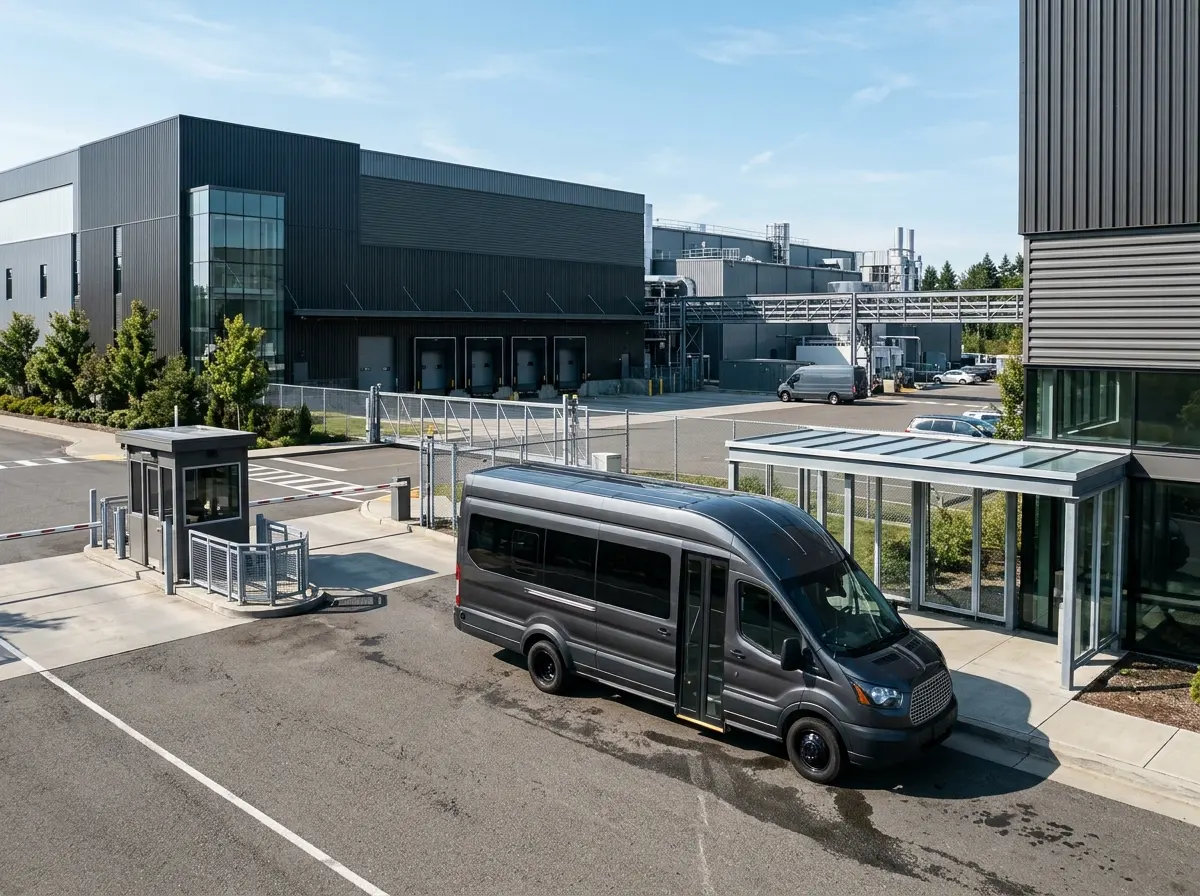 Illustrative image
Quick answer
Manufacturing employee transportation is a scheduled shuttle program that moves shift workers between pickup points and the plant gate, timed to shift change, plus transfers for visitors, auditors, executives and turnaround crews. Corporate Travel USA designs routes from shift and ridership data and coordinates them nationally through owned operations or vetted local partners confirmed per market. Pricing is by proposal.
The transportation problem
Manufacturing and Industrial: the transportation challenge
Manufacturing locations are often chosen for land, power and logistics, not for commuter access. A plant may sit 30 miles from the nearest large city, with little or no public transit, and run three shifts that start at 6:00, 14:00 and 22:00. Workers without reliable vehicles, or in areas with a tight labor supply, may not be able to reach the site. For some employers, a shuttle is a real answer to attendance and recruitment problems, not a perk.
Shift-based demand is different from office demand. A shuttle must be timed to shift change, which means a spike of boardings at the same minute, a return trip at the same time, and a reliable seat count. Safety rules at the gate and on site, such as badge procedures, PPE and restricted zones, affect how and where a vehicle can stop. A program like this runs as a recurring contract with ridership tracking, not as ad hoc bookings.
The second need is visitor and executive travel. Auditors, customers, suppliers and corporate leaders fly into a regional airport and need to reach a plant in a rural county. Local car service coverage is thin, drive times are long, and a visit may span several sites in a day. Planned shutdowns and maintenance outages bring in hundreds of contractors for a few weeks, another transportation spike. We scope each as its own program and confirm coverage by market.
Manufacturing and Industrial: typical use cases
Shift-change shuttles
Scheduled routes from pickup points to the plant gate, timed to shift starts and ends.
Plant visitor and supplier transfers
Pickups from regional airports and hotels for auditors, customers and suppliers visiting a facility.
Executive travel to remote sites
Corporate leaders moved between airport, plant and regional offices, often over long drives.
Turnaround and shutdown crews
Short-term transport for contractor crews during planned maintenance outages at refineries, mills or plants.
Training and recognition events
Group moves for offsite training, safety recognition days and plant open houses.
Booking and procurement for manufacturing and industrial
The vehicle is the easy part. These are the operational details that decide whether the program runs on time.
- 01
Route design from home areas
Aggregate and anonymize where employees live to design stops. Keep individual addresses out of vendor hands unless needed.
- 02
Shift timing and buffers
Align arrival with the gate process, not just the shift start. Late vehicles cost production time.
- 03
Site access and safety
Provide gate rules, PPE requirements and restricted zones in advance. Drivers complete site safety orientation where required.
- 04
Ridership data
Decide whether you want boarding counts by run, and who owns the data. This is a scoped option.
- 05
Pilot before scaling
Start with one route and one shift, then measure uptake before expanding.
Plant shuttle service: how do plants schedule shift shuttles?
Plants schedule shift shuttles backward from the gate: the shuttle must arrive early enough for workers to badge in, put on PPE and reach their stations before the shift starts, and it must leave after the outgoing shift has clocked out, not at the minute the shift ends.
Shift change is also an efficiency opportunity. The vehicle that drops the incoming shift can carry the outgoing shift home on the return, so one cycle serves both. Illustrative: at a 14:00 shift change, 60 riders come in and 55 go home. Two minibuses of about 30 seats (a typical range is 20 to 35) arriving around 13:30 drop the incoming riders, wait, and leave around 14:15 with the outgoing ones.
Patterns change more than headcount does. Twelve-hour rotations change who works which day, mandatory overtime delays returns, and weekend shifts may need a smaller vehicle. Ridership counts by run show where a route is oversized or missing riders.
| Shift starts | Shuttle at gate | Return departs | Watch for |
|---|---|---|---|
| 06:00 | 05:30 | About 06:15, with the night shift | Very early first pickups on long routes |
| 14:00 | 13:30 | About 14:15, with the day shift | Traffic on routes through town |
| 22:00 | 21:30 | About 22:15, with the swing shift | Lighting and safety at pickup points |
Related:Workforce transportation programsShuttle program planning guideMinibuses
Who can drive a plant shuttle, and for how long?
Who can drive a plant shuttle depends mainly on vehicle size. Under federal CDL rules, a vehicle designed to transport 16 or more passengers including the driver is a commercial motor vehicle (49 CFR 383.5), and its driver needs a commercial driver's license with a passenger endorsement (49 CFR 383.93).
Hours then shape staffing. A plant with shift changes at 06:00, 14:00 and 22:00 needs shuttles from before 05:00 until after 22:30, longer than one driver's working day. For interstate passenger-carrying vehicles, federal rules bar driving more than 10 hours after 8 consecutive hours off duty, or after 15 hours on duty (49 CFR 395.5). Most plant shuttles run intrastate under state rules, but the planning answer is the same: two or more drivers per vehicle per day.
Site rules add to this. Drivers may need a plant safety orientation, contractor badges, and instructions on speed limits, pedestrian crossings and where vehicles may stop inside the fence. This is one reason Corporate Travel USA supplies vehicles with professional drivers rather than vehicles for employees to drive themselves: licensing, hours and site onboarding are handled as part of the service.
How do you plan visitor, auditor and executive trips to a rural plant?
Plan rural plant visits as door-to-door itineraries confirmed before the trip: a named pickup at the regional airport or hotel, a driver who has the gate and visitor check-in instructions, a car that waits through the visit, and a return timed to the last realistic flight rather than to an optimistic end time.
Rural plants are where ad hoc transportation fails. Rideshare is thin or absent, taxis may need to come from the nearest city, and a customer auditor who lands at 22:00 at a regional airport cannot count on finding a ride. Multi-plant days add long drives between sites, so the itinerary has to be realistic about road time.
Planned shutdowns and maintenance turnarounds are a separate, temporary program: hundreds of contractors for a few weeks, moving from hotels or lots to the site on fixed shift times, scoped with their own start and end dates. What to send for a plant visit:
- Plant address and the right gate: visitor, main or truck entrance
- Visitor check-in steps and the PPE visitors must bring
- Visit schedule, including plant tours and meals
- Flights in and out, and the airports involved
- Number of sites and the order of visits
Related:Corporate airport transfersCity-to-city business travelConstruction and infrastructure
Vehicle categories
Vehicles for plant and shift shuttles
Categories, not guarantees. Availability varies by market and is confirmed in your proposal.
Minibuses
Roughly 20-35 passengers depending on vehicle type and layout
Chauffeured minibuses for groups of roughly 20-35: conference loops, offsites, employee routes and airport groups.
Motorcoaches
Roughly 47-56 passengers per full-size coach
Chauffeured charter buses for large groups, conventions, offsites and multi-city movements, quoted per itinerary.
Executive Sprinter Vans
Typically 9-14 passengers depending on configuration
Chauffeured Sprinter-class vans that keep a mid-size team together on airport runs, offsites and meeting days.
Executive SUVs
Typically 1-6 passengers depending on SUV class and luggage
Chauffeured business SUVs for small teams, extra luggage and travelers who want more space.
How a plant transportation program is set up
- 1
Understand the shifts
We collect shift times, headcount, gate processes and the areas where staff live.
- 2
Propose routes
Stops, schedules, vehicles and driver coverage are designed, with an option to pilot.
- 3
Complete site onboarding
Drivers are briefed on gate and safety rules before the first run.
- 4
Review ridership
Boardings and punctuality are reviewed and routes are adjusted.
Contracts, safety paperwork and billing for plants
- Recurring contract structure, scoped in the proposal
- Insurance certificates and vendor safety documentation on request
- Site-specific onboarding and safety orientation as the plant requires
- Invoicing by plant, shift or cost center, with purchase order references
Manufacturing and plant shuttle FAQs
Can you run shuttles timed to our shift changes?
We can propose them, based on your shift patterns and where workers live. Availability and vehicle types in a rural market are confirmed at proposal stage.
Do your drivers follow plant safety procedures?
Drivers can be briefed on your gate and safety requirements and complete any site orientation before service starts. Specific safety certifications are not claimed here and can be discussed against your requirements.
Can you move contractor crews during a shutdown?
We can scope temporary crew transport for a defined period, subject to confirmation of vehicles and drivers in the area.
Can visitors be picked up at a regional airport?
Yes, we can plan transfers from regional airports to a plant. Local coverage is confirmed per market, and drive times can be long.
Are plant shuttle rides a taxable benefit for employees?
It depends, and your tax advisers decide. IRS Publication 15-B treats rides in a commuter highway vehicle (seating at least six adults besides the driver, used mainly for commuting with at least half the seats filled by employees) as a qualified transportation benefit, with a 2026 monthly exclusion of $340 for commuter highway vehicle transportation and transit passes.
Sources and references
- 49 CFR 383.5, Definitions (commercial driver's license standards), Electronic Code of Federal Regulations (eCFR)
- 49 CFR 383.93, Endorsements, Electronic Code of Federal Regulations (eCFR)
- 49 CFR 395.5, Maximum driving time for passenger-carrying vehicles, Electronic Code of Federal Regulations (eCFR)
- Publication 15-B (2026), Employer's Tax Guide to Fringe Benefits, Internal Revenue Service
Next step
Discuss a corporate account
A short qualification so the right person can prepare a consultation or proposal.
We do not publish a response-time promise until it is operationally confirmed. Time-sensitive request? Say so in the notes.
Start your request
Related programs for manufacturers
- Workforce TransportationEmployee transportation for shift-based, plant, remote-site and temporary workforces, scoped around operating schedules rather than office hours.
- Employee Shuttle ProgramsScheduled employee shuttle service between offices, campuses and transit points, with routes and timetables designed around measured ridership.
- Dedicated Vehicle ContractsA private driver and vehicle assigned to your organization for a defined period, with hours, backup and term scoped in a proposal.
- Construction and InfrastructureCrew shuttles, remote job-site routes and owner-visit transportation for projects that move, with capacity that follows the manpower curve.
- Resources employee shuttle program planning