Short answer
Event transportation planning starts with movements, not vehicles: list every trip attendees make, find the busiest 30-minute window for each, and size vehicles from that peak. Then confirm venue access, check driver hours on long days, publish one schedule and write contingencies for delays and overruns. Corporate Travel USA plans and coordinates event transportation nationally, with vehicles confirmed per market and pricing by proposal.
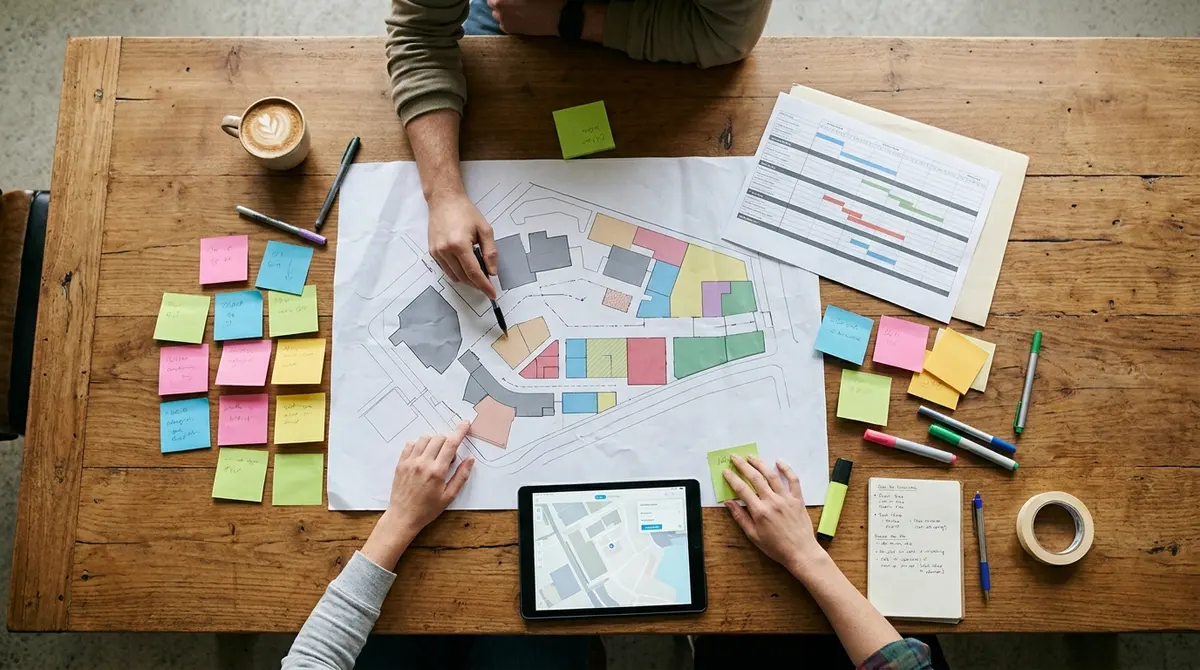 Illustrative image
How do you plan transportation for an event?
Plan event transportation in six steps: list the movements, estimate peak demand for each, choose vehicle types, check driver hours and venue access, publish a schedule, and write contingencies. Each step depends on the one before, so a vehicle count produced before the movements are listed is usually wrong.
Treat early numbers as ranges and update them as registration firms up. Keep a log of what changed and why; it is the best input for planning the next event.
- 1. Movements: every trip attendees make, from arrival to departure
- 2. Peak demand: riders in the busiest 30-minute window of each movement
- 3. Vehicles: type and count from peak demand and round-trip time
- 4. Constraints: driver hours, venue curb space, accessibility needs
- 5. Schedule: pickup points, times, frequency and the last return
- 6. Contingencies: delays, overruns, weather, breakdowns and VIP changes
Which movements does an event need?
Most corporate events involve five to seven distinct movements, and each has its own demand shape: airport arrivals come in waves, morning shuttles form one sharp peak, and late-night returns drain slowly with an unpredictable end. Listing them separately is what makes the vehicle plan accurate.
For each movement, record who travels, how many, when, and whether they move together or trickle. That one table becomes the brief for the transportation provider.
- Airport arrivals: waves tied to flight times; batch into windows and size by seats and bags
- Hotel to venue, morning: one sharp peak before the first session; size for the peak, not the day
- Venue to an offsite dinner or activity: a single timed departure where everyone leaves together
- Return from evening events: a slow drain; run a loop with a published last departure
- VIP and speaker moves: individual timing; dedicated sedans or SUVs, not the shared loop
- Departures to the airport: work backwards from flight times and add luggage loading time
How many vehicles does an event need?
Size vehicles from peak demand and round-trip time, not from total headcount. Take the number of people who need a seat in the busiest window, divide by seats per vehicle, then divide again by the number of runs each vehicle can make in that window.
Illustrative example: a 300-person event where 80 percent ride the morning shuttle puts 240 people on the move, and they must reach the venue between 8:00 and 9:00. With a 15-minute drive and 10 minutes of loading at each end, a round trip takes about 50 minutes, so plan one full run per coach in the window: 240 / (50 seats x 1 run) = 4.8, or five motorcoaches. If the hotel were 5 minutes away, the round trip would drop to about 30 minutes, each coach could make two runs, and 240 / (50 x 2) = 2.4, or three coaches.
This is planning arithmetic, not a promise about a real route. Traffic, curb space and attendee behavior change the answer, so add a margin for late risers, no-shows and breakdown cover.
- Peak riders = attendees using the movement x share traveling in the peak window
- Round trip = drive time each way + loading and unloading time at each end
- Vehicles = peak riders / (seats per vehicle x runs per vehicle in the window), rounded up
- Margin = a standby vehicle, or a named plan for one, sized to the event's risk
Which vehicle types fit each movement?
Match vehicle type to the movement: sedans and SUVs for VIPs and speakers, Sprinter-class vans for small groups, minibuses for frequent loops and motorcoaches for large peaks. Mixed fleets are normal; a coach loop for general attendees plus one or two premium vehicles on standby is a common pattern.
Typical capacities help with sizing, though configurations vary: Sprinter-class vans commonly seat 9 to 14, minibuses roughly 20 to 35 and full-size motorcoaches roughly 47 to 56. Availability is confirmed per market in a proposal, and supply tightens during large city-wide events, so settle vehicle types early. If a charter bus operator is new to you, FMCSA's Bus Safety Search shows whether it is authorized to operate, its safety rating and whether insurance is on file.
Collect accessibility needs at registration. Under the Department of Transportation's ADA rules, charter motorcoach operators must provide an accessible coach to a passenger with a disability who requests one, and may require up to 48 hours' advance notice (49 CFR 37.189). A planner who asks a week before the event is far better placed than one who learns at the curb.
How long can a driver work on an event day?
Under federal hours-of-service rules for passenger-carrying commercial vehicles, a driver may not drive more than 10 hours, or drive at all after being on duty for 15 hours, following 8 consecutive hours off duty (49 CFR 395.5). Long event days often run past those limits, so the plan needs driver changes or a schedule built around off-duty time.
Illustrative example: a coach reports at 6:30 a.m. for a breakfast shuttle and is released after a gala return at 11:00 p.m. That span is 16.5 hours. If the driver is on duty throughout, the 15-hour limit is reached before the gala ends, so the operator needs a second driver or a schedule with genuine off-duty time. That affects the vehicle plan, the timings and the quote, so share the full run of show early.
The federal limits apply to motor carriers subject to FMCSA rules, which generally means interstate operations; intrastate work follows state rules. Either way, ask the provider how it will schedule drivers across your event day.
What should the schedule and venue plan cover?
The schedule should let any attendee find a ride without asking anyone: pickup points, departure times, frequency during peaks, the last return and one contact number. The venue plan should confirm, in writing, where vehicles stop, how long they may wait, where they turn and where staff stand.
Review each hotel and venue for coach access. A motorcoach that cannot reach the door, or a curb that holds one vehicle when the plan assumes three, breaks the schedule on day one. Signage at pickup points matters more than most planners expect.
- Pickup point at each hotel, named the same way in every message
- Departure times and peak frequency for each movement
- Last departure from every venue, aligned with the program end
- Curb space, dwell-time limits and turnaround agreed with each venue
- Staff positions and signage at each stop
- One event contact and one transportation contact, with a rule for relaying changes
What goes wrong, and how should it be handled?
The predictable failures are delayed flights, overrunning sessions, weather, breakdowns, attendees at the wrong stop and last-minute VIP changes. Write a one-line rule for each before the event, naming who decides and how attendees are told.
Keep every change in one log. When three people give three answers at the curb, the plan has failed even if every vehicle is on time.
- Delayed flights: a maximum wait per wave, then a standby vehicle collects stragglers
- Session overrun: who can hold the shuttle, and for how long
- Weather: covered waiting areas, and a decision time for moving pickup points
- Breakdown: the replacement-vehicle source and expected arrival, confirmed with the provider
- Wrong stop: one message template that sends attendees to the nearest live stop
- VIP change: a dedicated vehicle or a named fallback, never the shared loop
When should each planning step happen?
Define movements and headcount as soon as the attendee list allows, request a proposal well before registration closes, confirm vehicle types and counts once registration stabilizes, publish the schedule before attendees travel, and run a final check with the venue and provider the day before. Exact lead times depend on event size and market.
Large events during busy convention weeks need the earliest start, because coach supply in any market is finite. After the event, record ridership by movement and the problems you saw; next year's plan starts from that record.