Corporate Programs
Employee Transportation Built Around Shifts, Plants and Sites
Transportation planned around operating schedules: shift changes, plant gates, remote sites and temporary crews, rather than office hours.
Updated
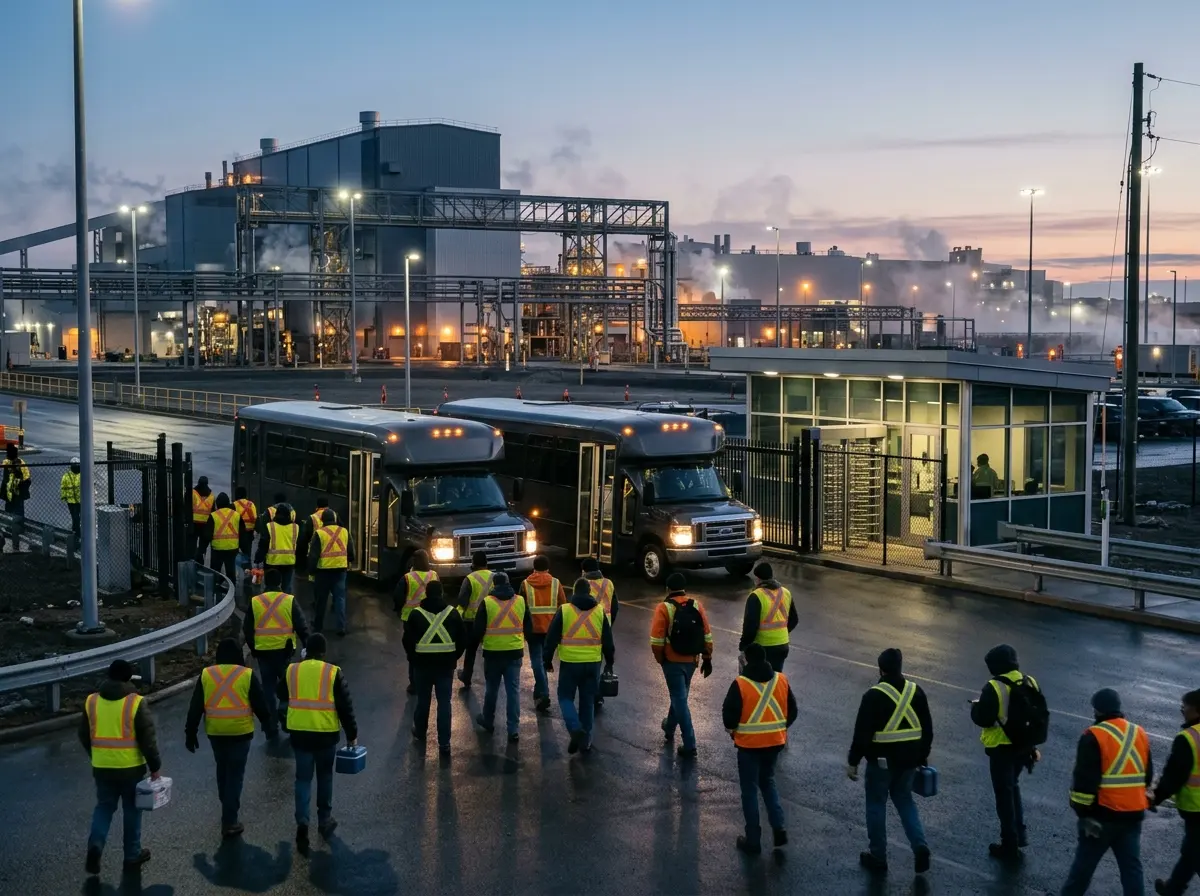 Illustrative image
Quick answer
Employee transportation for operations moves shift workers, plant staff, remote-site crews and temporary workforces on schedules set by production, not office hours. Corporate Travel USA plans each program around shift times, headcounts, site access and driver-hour limits, and coordinates it nationally through owned operations or vetted local partners confirmed per market. Early, overnight and remote work is verified site by site, and pricing is by proposal.
How it works
How employee transportation works
Workforce transportation is not employee shuttling with a different label. Office shuttles follow a business day. Workforce transport follows operations: a shift change at 5:45 a.m., a plant gate with a security check, a remote site with no transit option, or a temporary workforce that arrives for eight weeks and leaves.
The planning questions are different. How many people on each shift? Is there overlap at changeover? What happens when production runs late? Who confirms the headcount on the vehicle? A proposal starts from those operational facts.
Corporate Travel USA coordinates ground transportation across the United States. Service in a given market is delivered by owned operations or qualified local transportation partners, and what is feasible at a specific site is confirmed at proposal stage. Early-morning, overnight and remote work in particular needs verification market by market.
Workforce transportation: where it fits
Shift-change service
Scheduled runs timed to the start and end of shifts at plants, warehouses or processing sites.
Plant and industrial campus
Movement between parking, gates and production areas, including security check requirements.
Remote-site crews
Daily or rotation-based transport to sites outside normal transit reach, such as construction or energy projects.
Temporary workforce programs
Transport for seasonal or project-based workers, started and ended on a defined date.
Turnaround and outage support
Short, high-volume programs during maintenance shutdowns when extra labor arrives.
What we plan for in employee transportation
The vehicle is the easy part. These are the operational details that decide whether the program runs on time.
- 01
Plan by shift, not by day
Rider counts differ by shift, and the changeover is the peak. Capacity should match it.
- 02
Handle site access
Gate procedures, badge checks and driver credentials may be required. Clarify them before service starts.
- 03
Build in overrun rules
Decide how late-running shifts are handled and who authorizes extra time.
- 04
Verify driver availability
Overnight, early-morning and remote runs depend on driver-hour rules and local resources, confirmed per market.
- 05
Define the start and end
Temporary programs need clear dates, ramp-up and wind-down.
How is shift-change transportation planned?
Shift-change transportation is planned around the changeover, when one shift arrives and another leaves through the same gate within minutes. Corporate Travel USA sizes the program for that peak: inbound and outbound headcounts per shift, gate-to-gate travel time, and how long boarding and security checks take.
Changeovers can be efficient when the timing works, because a vehicle that drops the incoming shift can load the outgoing one. That only holds if shifts release on time. Production overruns, mandatory overtime and staggered release times break the pattern, so the plan needs an agreed rule for how long vehicles wait and who authorizes extra time.
In the illustration below, the 6:00 a.m. and 2:00 p.m. changeovers set the vehicle count, while the 10:00 p.m. changeover sets the driver plan, because it falls outside the working day of drivers who started at dawn.
| Changeover | Inbound riders | Outbound riders | Planning note |
|---|---|---|---|
| 6:00 a.m. | 140 (day shift) | 40 (night shift) | Inbound peak: size for 140 within the arrival window |
| 2:00 p.m. | 90 (swing shift) | 140 (day shift) | Outbound peak: confirm release time and the waiting rule |
| 10:00 p.m. | 40 (night shift) | 90 (swing shift) | Late run: a different driver team from the early start |
Shift worker transportation: early, overnight and weekend runs
Shift worker transportation outside the business day is limited less by vehicles than by driver hours. Under FMCSA hours-of-service rules for passenger-carrying drivers, a driver may drive a maximum of 10 hours after 8 consecutive hours off duty and may not drive after 15 hours on duty, so early and late changeovers usually need separate driver teams.
As an illustration: a driver who comes on duty at 5:00 a.m. for a 6:00 a.m. changeover reaches 15 hours on duty at 8:00 p.m., before a 10:00 p.m. changeover. That driver then needs 8 consecutive hours off before the next early start. The federal rules also stop driving after 60 hours on duty in 7 consecutive days, or 70 hours in 8, which matters for seven-day operations. These rules apply to commercial passenger vehicles in interstate commerce; runs within one state may fall under state rules, which can differ, and the proposal states which apply.
- Name every service window, including weekends and holidays, before vehicles are discussed.
- Expect separate driver coverage for early and late changeovers in most patterns.
- Plan for weather and road conditions on dark, early or remote runs.
- Confirm overnight and early-morning availability market by market; it is never assumed.
How do you transport a temporary workforce?
A temporary workforce is transported on a dated program: a ramp-up as workers arrive, a steady-state schedule, and a wind-down as the project or season ends. Corporate Travel USA scopes each phase separately, because headcount, pickup points and timing change between them.
Temporary programs fail on rosters more often than on vehicles. Who is on which shift this week, which hotel or housing each person is in, and who confirms the headcount on the vehicle should each have a named owner on your side. Moving crews as a group also tends to beat leaving each person to find their own way: in a GBTA and National Limousine Association survey of 121 travel managers (June 2024), 63% said shuttles or vans are more cost-effective for group and project travel than employees taking separate transportation, and 79% said they are more sustainable.
- Dates: first arrival, steady state and last departure, with notice rules for changes.
- Pickup points: hotels, temporary housing, park-and-ride lots or a central muster point.
- Roster owner: the person who sends shift lists and confirms headcounts.
- Travel days: airport or rail transfers at the start and end of the assignment.
- Turnarounds and outages: short, high-volume windows planned as a phase of their own.
Related:Construction and infrastructureGroup airport transfers
Site access, headcount and safety on the vehicle
Plants, warehouses and job sites usually control who and what passes the gate, so site access is planned before the first run: driver credentials, vehicle registration with security, permitted drop-off points and any site safety briefing. Corporate Travel USA records those requirements in the proposal so they are confirmed for each location.
Headcount control matters for safety and for billing. A simple manifest per run, checked against the shift roster, shows who is on the vehicle and who missed it. Driver qualifications follow vehicle size: under FMCSA standards, a vehicle designed to transport 16 or more passengers, including the driver, requires a commercial driver's license, and passenger drivers need the passenger endorsement. If a rider needs an accessible motorcoach, raise it early: FMCSA notes that charter over-the-road bus operators may require 48 hours' advance notice to transport passengers with disabilities.
- Gate procedures: badge checks, escort rules, vehicle inspection at entry.
- Drop-off points: safe walking routes from vehicle to work area.
- Manifests: per-run headcount checked against the roster, if scoped.
- Incidents: who is notified and how, written into the agreement.
Remote-site crew transportation: distance, staging and weather
Remote-site crew transportation is planned around the drive itself: long distances, limited parking at the site, unpaved or seasonal roads, and the chance that weather closes the route. Feasibility at a specific site is confirmed at proposal stage, because local operator resources thin out the further a site is from a metro area.
Long drives change the arithmetic. As an illustration, a 75-minute trip each way adds two and a half hours of driver time to every shift, and that time counts toward the driver-hour limits described above. Staging, where vehicles and drivers wait near the site instead of returning to base, can cut empty mileage but needs a safe place to wait. A muster point, where crews gather at a park-and-ride lot or hotel for one departure, is usually more reliable than door-to-door pickups.
- Send: site location, access road conditions, shift times, crew sizes and the nearest town.
- Agree: a weather and road-closure rule, including who decides and how crews are told.
- Plan: a muster point and a backup approach for breakdowns far from base.
Vehicle categories
Vehicles for employee transportation
Categories, not guarantees. Availability varies by market and is confirmed in your proposal.
Executive Sprinter Vans
Typically 9-14 passengers depending on configuration
Chauffeured Sprinter-class vans that keep a mid-size team together on airport runs, offsites and meeting days.
Minibuses
Roughly 20-35 passengers depending on vehicle type and layout
Chauffeured minibuses for groups of roughly 20-35: conference loops, offsites, employee routes and airport groups.
Motorcoaches
Roughly 47-56 passengers per full-size coach
Chauffeured charter buses for large groups, conventions, offsites and multi-city movements, quoted per itinerary.
How an engagement for employee transportation services works
- 1
Describe the operation
Shifts, headcounts, sites, access rules and start dates.
- 2
Review the proposed program
We outline routes, schedules, vehicle sizes and how exceptions would be handled.
- 3
Confirm feasibility at each site
Delivery, hours and access are confirmed for each location.
- 4
Launch and review
Service begins with an early review of headcount and timing.
Employee transportation: procurement and billing
- Term and ramp-up can be proposed for temporary programs; none is promised until an agreement is confirmed.
- Site safety, access and credential requirements can be addressed in the agreement.
- Insurance certificates available on request, subject to confirmation.
- Billing by site or project code can be scoped in the proposal.
Employee transportation FAQs
How is this different from employee shuttle programs?
Employee shuttles generally follow office or campus schedules. Workforce transportation follows operations: shifts, plant gates, remote sites and temporary crews, with different peak and access issues.
Can you serve remote sites?
Possibly. It depends on location, distance and local resources. Feasibility is confirmed at proposal stage.
Do you handle overnight shifts?
Overnight and early-morning service can be proposed, subject to market confirmation and driver availability. Driver-hour limits usually mean separate driver teams for early and late changeovers.
What if a shift runs late?
The agreement should set a waiting rule: how long vehicles wait after scheduled release, who can authorize extra time and how extra time is billed. Without one, late releases become daily disputes.
Who confirms the headcount on each run?
Your roster owner supplies shift lists, and a per-run manifest can be scoped so riders are checked against it. That record also supports billing by site or project code.
Can we run a short program for temporary labor?
Yes. A proposal can be requested for a defined, short period. No term is promised until an agreement is confirmed.
How is employee transportation priced?
By proposal. The main drivers are vehicle hours across all changeovers, vehicle classes, distance to the site, early or overnight work and the program term. Rates are not published.
Sources and references
- Summary of Hours of Service Regulations, Federal Motor Carrier Safety Administration (FMCSA)
- Commercial Driver's License Program: Drivers, Federal Motor Carrier Safety Administration (FMCSA)
- Accessibility for Buses: Americans with Disabilities Act (ADA) Regulations and Rights, Federal Motor Carrier Safety Administration (FMCSA)
- Safety, Sustainability and Cost Drive Today's Business Travel Ground Transportation Strategies, According to New Research, Global Business Travel Association (GBTA)
Next step
Discuss a corporate account
A short qualification so the right person can prepare a consultation or proposal.
We do not publish a response-time promise until it is operationally confirmed. Time-sensitive request? Say so in the notes.
Start your request
More like employee transportation
- Employee Shuttle ProgramsScheduled employee shuttle service between offices, campuses and transit points, with routes and timetables designed around measured ridership.
- Manufacturing and IndustrialShift-change plant shuttles, visitor and auditor transfers and executive travel to rural facilities, planned around production schedules.
- Construction and InfrastructureCrew shuttles, remote job-site routes and owner-visit transportation for projects that move, with capacity that follows the manpower curve.
- Fleet minibuses
- Fleet motorcoaches
- Request a proposal