Events and groups
Corporate event transportation, planned before the first guest arrives
We coordinate the vehicles, routes, loading zones and dispatch behind your event so guests spend their time at the event, not waiting for a ride. Every program is scoped to your venue and headcount in a proposal.
Updated
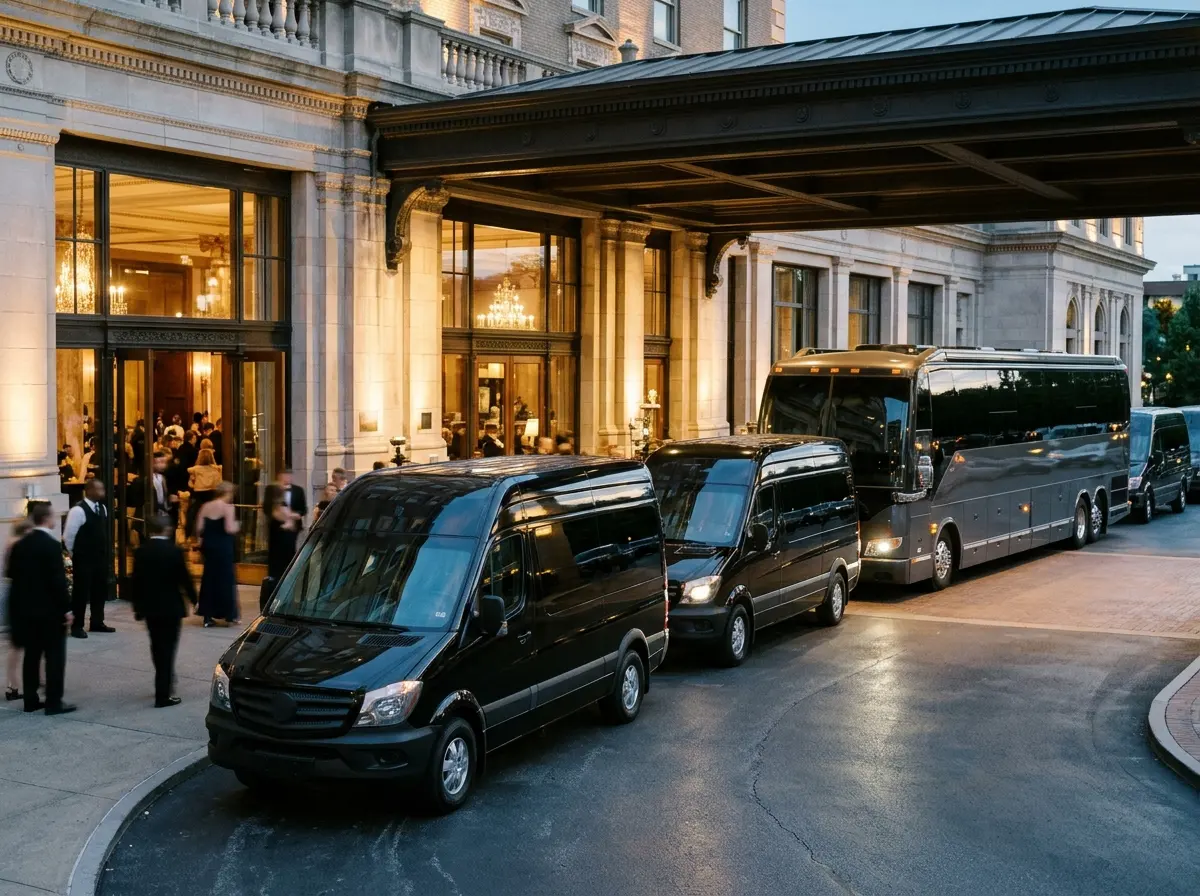 Illustrative image
Quick answer
Corporate event transportation is the planned movement of attendees, speakers and executives between hotels, airports and event venues to an agreed schedule. It suits conferences, client summits, galas and company meetings. Corporate Travel USA coordinates it nationally: we build the movement plan, then deliver it through owned operations or qualified local partners confirmed for each market. Pricing is by proposal.
How it works
How corporate event transportation works
Event transportation fails in small, predictable places: a loading zone nobody reserved, a manifest that was last updated three days ago, a driver who has never seen the venue's service entrance. Our job is to find those places on paper first. We start with the guest list, the arrival pattern and the venue, then build a movement plan that names each pickup point, each route and each vehicle assignment.
That plan is usually one of three shapes. A point-to-point program moves defined groups between two locations at set times. A continuous loop keeps vehicles circulating between a hotel and a venue. An on-demand program holds a smaller pool of vehicles that a dispatcher sends where they are needed. Most corporate events blend two of these, for example a scheduled morning loop and on-demand evening returns.
Corporate Travel USA coordinates ground transportation across the US. Depending on the market, vehicles are supplied by owned operations or by qualified local transportation partners, and the supplier for your city is confirmed at proposal stage. You work with one planning contact rather than managing each operator yourself.
Corporate event transportation: where it fits
Client summits and customer conferences
Mixed arrivals, hotel blocks and an evening function off-site. We plan wave-based shuttles in the morning and a staggered return after dinner.
Executive offsites and board dinners
Small groups, tight start times and senior attendees who should not be queuing. Typically sedans, SUVs and sprinter-class vans with named drivers.
Product launches and press days
Guests arrive in a narrow window and often include media and VIPs. Separate staging for each guest type keeps arrivals orderly.
Company-wide meetings and town halls
Large headcounts from several offices or hotels converge on one venue. Motorcoaches handle the volume, with vans covering stragglers and late arrivals.
Awards evenings and galas
A concentrated drop-off peak followed by a staggered exit. Planning focuses on queue order, curb time and the point at which vehicles are released.
What we plan for in corporate event transportation
The vehicle is the easy part. These are the operational details that decide whether the program runs on time.
- 01
Headcount to vehicle mix
We work from confirmed attendees, not invitations. A typical full-size motorcoach seats 47 to 56 and a sprinter-class van commonly seats 9 to 14, so the mix depends on how many people move in the same window.
- 02
Staging and loading zones
We ask the venue early about curb space, permits, turning radius, height restrictions and where large vehicles may wait. A staging area away from the entrance keeps the loading zone clear.
- 03
Passenger manifests and credentialing
Where access is controlled, vehicles are matched to guest lists, and drivers are briefed on what credentials, wristbands or names they check. Manifest changes have a cut-off we agree in advance.
- 04
Spare capacity
We typically plan a reserve of vehicles that is not assigned to a route. The size of that reserve depends on the event's tolerance for delay, and we state it in the proposal.
- 05
Dispatcher coordination
A named dispatcher is the single point of contact for your on-site lead. We agree who can authorize changes, how requests are relayed and what happens when a flight or session runs late.
How do event transportation services work for a corporate event?
Event transportation services for a corporate event turn a guest list and an agenda into a movement plan: who travels, from where, at what time, in which vehicle and through which loading point. Most programs use one of three service shapes, or a blend of two.
The shape follows the movement, not the vehicle. A gala with one outbound time and one venue is a set of scheduled departures. Two hotels feeding a conference center all day is a loop. A board dinner with executives leaving at different times is an on-demand pool. Choosing the wrong shape is the most common reason an event either runs short of vehicles at the peak or pays for empty seats the rest of the day.
A typical corporate program blends them: scheduled departures for the morning keynote, a loop between hotels during the day, and an on-demand pool for executives and late returns. The movement plan names each layer separately, with its own vehicles, so a delay in one layer does not quietly consume vehicles from another.
| Service shape | Best for | What sets the vehicle count | Watch-out |
|---|---|---|---|
| Scheduled departures | Defined groups at set times: hotel to gala, venue to dinner | Headcount per departure divided by a realistic load per vehicle | Late guests miss the departure, so a catch-up vehicle is planned |
| Continuous loop | Many attendees, short distances, all-day flow between hotels and a venue | Round-trip time divided by the target interval between vehicles | Vehicles bunch together if dwell time at stops is not controlled |
| On-demand pool | Executives, speakers and scattered evening returns | The number of simultaneous requests the dispatcher must cover | Needs one request channel and a rule for who can authorize a ride |
Related:Conference transportationConvention shuttle servicesEvent planning guide
How many vehicles does an event need?
An event needs enough vehicles to move its largest group inside its tightest time window, plus a reserve. The count comes from three numbers: how many people move in that window, how many each vehicle realistically carries, and how many round trips each vehicle can finish before the window closes. The loading curb then decides whether that fleet can actually leave on time.
Illustrative example (planning arithmetic, not a quote and not a past program): 400 attendees must reach an 8:30 a.m. keynote from two hotels, 250 at Hotel A and 150 at Hotel B, each about 15 minutes from the venue. Planning at 46 passengers per full-size motorcoach, below the typical 47 to 56 seats to absorb bags and slow boarding, Hotel A needs 6 coach departures and Hotel B needs 4.
Round-trip time decides whether a coach can be reused. With about 12 minutes to load, 15 to drive, 5 to unload and 15 to return, a cycle takes roughly 45 to 50 minutes. If boarding runs only from 7:30 to 8:10, each coach makes one useful trip and the event needs 10 coaches on the line. Open boarding at 7:00 with breakfast at the venue, and some coaches run twice, bringing the line to about 6.
Then check the curb. One loading bay dispatches roughly 60 divided by (load time plus pull-in and pull-out time) vehicles an hour. At about 15 minutes per departure, a single bay handles about 4 coaches an hour, so Hotel A's 6 departures need two or three bays depending on the window. The curb, not the fleet, is often the real limit.
| Planning figure | Boarding 7:30 to 8:10 | Boarding 7:00 to 8:10 |
|---|---|---|
| Coach departures needed | 10 (6 from Hotel A, 4 from Hotel B) | 10 (6 from Hotel A, 4 from Hotel B) |
| Trips per coach (45 to 50 minute cycle) | 1 | Up to 2 |
| Coaches on the line | 10 | About 6 |
| Loading bays needed at Hotel A (about 15 minutes per departure) | 3 | 2 |
| Reserve | 1 coach or 2 vans at the venue | 1 coach or 2 vans at the venue |
What does an event shuttle service need at the venue?
An event shuttle service needs three things from the venue: a legal loading zone with enough bays for the planned departures, a staging area where waiting vehicles do not block the curb, and agreed access rules for vehicles and drivers. Without them, a well-sized fleet still ends up queuing in the street.
Venues rarely volunteer these details, so we ask for them in writing early. Convention centers, hotels and private venues each control curb space differently, and some require vehicle registration, an insurance certificate or a commercial-vehicle permit before the event. Where large vehicles cannot wait at the door, a staging lot a few minutes away, with the dispatcher calling vehicles forward one or two at a time, keeps the loading zone clear.
Signage closes the loop. Guests need the pickup point, the departure times or interval, and a number to call, posted where they leave the session rooms rather than only at the curb.
- How many vehicles can load at once, and how long each may stand
- Height, length and turning limits on the approach; motorcoaches need far more room than vans
- Where vehicles may stage between runs, and how far that is from the loading zone
- Whether vehicles, plates or drivers must be registered or credentialed in advance
- The step-free boarding point for guests who use wheelchairs or cannot climb steps
- Idling rules, quiet hours and any curb shared with deliveries or exhibitor freight
Related:Conference shuttle checklistTrade show transportation
Who runs event transportation on the day?
On the day, a named dispatcher runs the transportation program against the movement plan, and your on-site lead is the only person who can change the plan. Between them sit the people who make it physical: loading marshals at busy curbs, greeters where guests need directing, and drivers briefed on the venue.
The manifest is the document they share. It is a version-controlled list of who should be on which departure, with a cut-off agreed in advance and one owner on each side. Changes after the cut-off are handled from the reserve and logged. At boarding, marshals count heads against the manifest, so your lead can answer one question at any moment: who is still missing?
Spare capacity is sized to what a delay would cost, not to a fixed percentage. As illustrative guidance, hold at least one reserve vehicle of the largest class in use at the staging area, unassigned to any route, and add more for executive-heavy programs, winter weather or venues with a single long approach.
- Vehicle late or out of service: the reserve leaves staging and the next departure absorbs passengers
- Session overruns: the dispatcher holds departures and releases them in order
- Guest misses a departure: the catch-up rule agreed in advance applies, usually a van from the reserve
- Venue closes the curb: pickup moves to the staging lot and greeters walk guests across
| Role | What they do | Typically provided by |
|---|---|---|
| Your transportation lead | Owns the guest list, approves changes, decides VIP exceptions | Your company or event agency |
| Dispatcher | Tracks every vehicle against the plan, releases the reserve, logs changes | Corporate Travel USA or the confirmed local supplier, as scoped |
| Loading marshal | Counts boarding, keeps the queue in order, sends vehicles on time | Scoped for busy curbs |
| Greeter | Directs guests from arrival halls or session exits to the vehicles | Scoped where guests need directing |
| Driver | Runs the assigned route, reports delays, checks names where required | Owned operations or a qualified local partner |
Related:Multi-day eventsDuty of care
How to choose an event transportation company
Choose an event transportation company on evidence you can check: active federal operating authority for the vehicles it will use, insurance on file, properly licensed drivers, a written plan for driver hours and accessibility, and a named dispatcher. A low quote without those is not a comparable quote.
For buses and motorcoaches, FMCSA's Bus Safety Search shows a company's operating authority, safety rating and insurance, and FMCSA suggests searching by USDOT number because many company names are similar. A vehicle designed to carry 16 or more passengers, counting the driver, requires a commercial driver's license, and FMCSA advises planners to ask whether drivers hold the passenger endorsement.
Corporate Travel USA coordinates event programs across the US. Service in each market is delivered by owned operations or a qualified local partner, and the operator for your city is named in the proposal so your team can run these checks on us as on anyone else.
- Which company will operate each vehicle, and what is its USDOT number?
- How are driver hours planned? FMCSA limits passenger-carrying drivers to 10 hours of driving after 8 consecutive hours off duty
- How are accessible vehicles sourced? Charter motorcoach operators may require up to 48 hours' notice under DOT ADA rules
- Who is the dispatcher on the day, and who can authorize changes?
- Where is the reserve, and what happens when a vehicle fails?
- What are the change, cancellation and waiting terms, in writing?
Related:Transportation standardsRFP checklistRequest a proposal
Vehicle categories
Vehicles for corporate event transportation
Categories, not guarantees. Availability varies by market and is confirmed in your proposal.
Executive Sedans
Typically 1-3 passengers
Chauffeured business-class sedans for individual executives and small teams on airport, meeting and city-to-city runs.
Executive SUVs
Typically 1-6 passengers depending on SUV class and luggage
Chauffeured business SUVs for small teams, extra luggage and travelers who want more space.
Executive Sprinter Vans
Typically 9-14 passengers depending on configuration
Chauffeured Sprinter-class vans that keep a mid-size team together on airport runs, offsites and meeting days.
Minibuses
Roughly 20-35 passengers depending on vehicle type and layout
Chauffeured minibuses for groups of roughly 20-35: conference loops, offsites, employee routes and airport groups.
Motorcoaches
Roughly 47-56 passengers per full-size coach
Chauffeured charter buses for large groups, conventions, offsites and multi-city movements, quoted per itinerary.
How a corporate event transportation engagement works
- 1
Brief
You share the event date, venue, headcount range, hotel blocks and any security requirements. A planner reviews the venue access details.
- 2
Movement plan
We draft routes, pickup points, vehicle mix and spare capacity, and send a proposal with the supplier confirmed for each market.
- 3
Lock and brief
Manifests, times and contacts are frozen at an agreed cut-off. Drivers and the dispatcher are briefed on the venue and the plan.
- 4
Run and review
A dispatcher coordinates on the day and logs changes. Afterward we review what the data showed so the next event starts better informed.
Corporate event transportation: procurement and billing
- Pricing by proposal, scoped to the movement plan rather than a flat per-vehicle rate
- PO numbers and event codes can be carried onto invoices; invoicing format is agreed in the proposal
- Insurance certificates available on request for venue and security review
- Single point of contact across multiple local suppliers
Corporate event transportation FAQs
How much does corporate event transportation cost?
There is no meaningful flat price, because cost follows the movement plan. The main drivers are the number and class of vehicles, the hours each is committed (including any minimum booking period and time to reach the venue), the number of drivers needed to stay within hours-of-service limits, the reserve, peak dates, and venue or airport fees. We price each program by proposal and write those assumptions out so you can compare like with like.
How far in advance should event transportation be booked?
Start as soon as the venue, dates and a headcount range are fixed. Lead time grows with event size, peak-season dates, smaller markets where local supply is thin, venue permits and accessible vehicles. The proposal states when vehicle supply needs to be locked for your dates.
How many vehicles does an event need?
Enough to move the largest group inside its tightest window, plus a reserve. Divide the people in that window by a realistic load per vehicle, adjust for how many round trips fit in the window, and check that the loading curb can dispatch that many vehicles in time. We run that arithmetic on your real headcount, venue and timings.
What is the difference between an event shuttle and a charter transfer?
An event shuttle runs repeatedly between fixed points, and guests board whichever vehicle comes next. A charter transfer moves a defined group at a set time. Shuttles suit all-day flows between hotels and a venue; transfers suit dinners, galas and airport moves, and many events use both.
Who is on site on the day?
A dispatcher coordinates the program and is your point of contact. Whether we place a staff lead, loading marshals or greeters at the venue is a scoping decision that depends on event size and complexity.
What if attendance changes late?
We plan spare capacity for exactly this reason and agree a manifest cut-off in advance. Changes after the cut-off are handled from the reserve where possible, subject to confirmation.
Can you handle events in more than one city?
Yes. We coordinate across US markets, with local supply confirmed per city at proposal stage. For a tour of repeated events, see roadshow event logistics.
Can you provide wheelchair-accessible vehicles?
Yes, sourced specifically for the date and market. Tell us at the brief stage: DOT rules let charter motorcoach operators require up to 48 hours' notice for an accessible coach, and lift boarding adds time that the schedule must absorb.
Sources and references
- Look Before You Book: Put Bus Safety First, Federal Motor Carrier Safety Administration (FMCSA)
- Safety Tips (Travel Planners), Federal Motor Carrier Safety Administration (FMCSA)
- Commercial Driver's License: Drivers, Federal Motor Carrier Safety Administration (FMCSA)
- Accessibility for Buses: Americans with Disabilities Act (ADA) Regulations and Rights, Federal Motor Carrier Safety Administration (FMCSA)
Next step
Request an event transportation proposal
Tell us about the event, the movements and the passenger count. We will reply with a proposal for review.
We do not publish a response-time promise until it is operationally confirmed. Time-sensitive request? Say so in the notes.
Start your request
More like corporate event transportation
- Large Group TransportationMoving a large group on a schedule: motorcoach and van mixes, wave planning and spare capacity.
- Conference TransportationHotel-to-venue shuttles, airport arrivals and session-driven peaks planned for multi-day conferences.
- VIP Delegation TransportationProtocol-aware transportation for executive delegations and visiting dignitaries, with discreet vehicles and security coordination.
- Corporate Event AgenciesA ground transportation provider for event agencies and DMCs: attendee flows, run-of-show timing and itemized proposals that fit the client budget.
- Resources corporate event transportation planning guide
- Request a proposal