Corporate Programs
Employee Shuttle Service Built Around Your Ridership
Scheduled shuttle service between offices, campuses, parking sites and transit stations, designed around how many people ride and when.
Updated
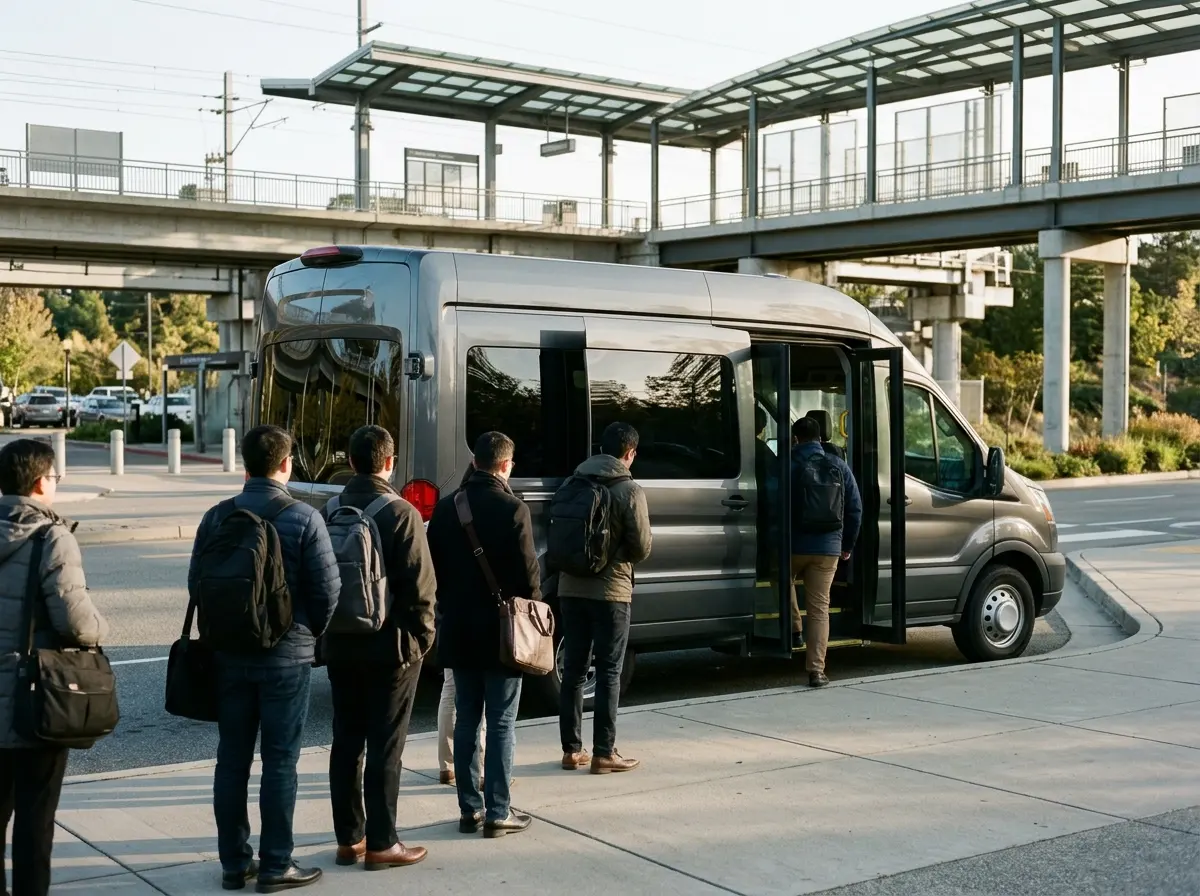 Illustrative image
Quick answer
An employee shuttle service is scheduled transportation that moves staff between offices, campuses, parking sites and transit stations on a fixed timetable. Corporate Travel USA designs each program from ridership: routes, frequency and vehicle size are proposed from measured demand, then adjusted after launch. Service is coordinated nationally and delivered by owned operations or vetted local partners, confirmed per market, with pricing by proposal.
How it works
How employee shuttle service works
An employee shuttle succeeds or fails on one question: does the timetable match when people need to travel? A route that runs empty off-peak and overflows at 8:45 costs money and loses trust. Good shuttle planning starts with ridership, not vehicles.
We work with you to describe the rider base, the stops, the arrival windows and the days that matter, and then propose a shuttle program: route design, timetable, vehicle sizing, contract terms and, where you need it, ridership reporting as a scoped option. Routes, frequency and vehicle size can be adjusted after launch as real ridership appears.
Corporate Travel USA coordinates shuttle service nationwide. Depending on the market, it is delivered by owned operations or qualified local transportation partners, confirmed at proposal stage. Among employee transportation services, this page covers scheduled shuttles for offices, campuses and transit links; event shuttles are planned per event, and shift-based plant and site transport is covered under workforce transportation.
Where a corporate shuttle service fits
Transit-station connector
A loop between a train or bus station and an office park where the last mile is the barrier to commuting.
Multi-building campus loop
Frequent short runs between buildings, parking structures and visitor centers for large campuses.
Office-to-office link
Scheduled movement between two nearby sites, such as headquarters and an engineering annex.
Remote parking shuttle
Service from overflow or off-site parking to the main entrance on peak days.
Temporary relocation support
Short-term service while a site is under renovation or a team is relocating.
What we plan for in employee shuttle service
The vehicle is the easy part. These are the operational details that decide whether the program runs on time.
- 01
Measure demand honestly
A short rider survey or badge-swipe pattern gives a better starting point than a guess. Programs often begin smaller and grow as ridership is measured.
- 02
Match vehicle to load
A Sprinter-class van commonly seats 9 to 14 depending on configuration, a minibus roughly 20 to 35, and a full-size motorcoach commonly 47 to 56. Peak and off-peak may call for different vehicles.
- 03
Plan the stops and timing
Dwell time, curb space and building access shape the real schedule more than distance does.
- 04
Consider accessibility
Riders who need lift- or ramp-equipped vehicles should be identified early so the proposal can address them.
- 05
Define a review loop
Schedule a check-in after launch to adjust frequency and routes against actual use.
How are employee shuttle routes planned?
Employee shuttle routes are planned backwards from arrival windows: when riders need to be at work, where they start, and how long a full loop really takes including stops. Corporate Travel USA proposes a route, a timetable and a vehicle size from those facts, then tests them against real ridership after launch.
The key number is cycle time: the minutes a vehicle needs to complete one loop and be ready to start the next. Divide cycle time by the headway you want (the gap between departures) and you have the number of vehicles needed at peak. Curb access, security gates, building entrances and peak-hour traffic change cycle time far more than distance does, so they are timed on the ground rather than estimated from a map.
In the illustration below, a single vehicle would leave a 30-minute gap at peak, which few commuters will wait for. Off-peak, the same route might drop to one vehicle, or to on-request service.
| Planning step | Example figure | Result |
|---|---|---|
| Drive time each way at peak | 12 minutes | 24 minutes driving per loop |
| Dwell at station and campus | 3 minutes each | 6 minutes per loop |
| Cycle time | 24 + 6 minutes | 30 minutes |
| Target headway | A departure every 10 minutes | 30 / 10 = 3 vehicles at peak |
| Peak riders, 8:00 to 9:00 a.m. | 120 riders over 6 departures | About 20 riders per departure |
| Vehicle fit | 20 riders per departure | Minibus class (typically 20-35 seats), not a Sprinter-class van (typically 9-14) |
How do you measure shuttle ridership?
Shuttle ridership is measured per departure and per stop: how many people boarded, where, and the highest number on board at any point in the run. Collected over several weeks, those counts show whether the timetable and vehicle size match demand, and they are the basis for every later change.
Counting methods range from a driver tally on each run to scanned check-ins or badge data, depending on what your site already captures and what is scoped in the proposal. Whatever the method, the useful outputs are the same: boardings by departure, peak load against seats available, riders left at the curb because a vehicle was full, and how ridership moves by day of week. In hybrid workplaces, Monday and Friday patterns can differ sharply from midweek, so a weekly average can hide the real peak.
- Boardings per departure and per stop: shows which runs and stops carry the route.
- Peak load as a share of seats: an illustrative review trigger is a run that is routinely above about 85% full, or below about 30%. Your program sets its own thresholds.
- Pass-ups: one rider left behind is a stronger signal than any average.
- Day-of-week pattern: plan for the real peak days, not the weekly mean.
- Reporting format and frequency: options scoped in the proposal, such as a monthly ridership summary.
Corporate shuttle bus or van? Matching the vehicle to peak load
Choose the corporate shuttle bus or van from the busiest departure, not the daily total: the vehicle has to carry the peak run without leaving riders behind. As typical figures, a Sprinter-class van seats 9 to 14, a minibus roughly 20 to 35 and a full-size motorcoach roughly 47 to 56, depending on configuration.
Vehicle size also changes the driver requirement. Under FMCSA's commercial driver's license standards, a vehicle designed to transport 16 or more passengers, including the driver, requires a CDL, and drivers of passenger vehicles need the passenger (P) endorsement. That is one reason a mixed pattern, larger vehicles at peak and a van off-peak, is often more practical than one size all day.
Accessibility needs planning as well. The U.S. DOT's ADA transportation rule (49 CFR 37.37(d)) treats transportation an employer provides solely for its own employees as outside Part 37, governed instead by the EEOC's ADA Title I rules, so rider accommodation is handled as an employment matter. In practice, identify riders who need a lift- or ramp-equipped vehicle during scoping so the proposal includes it, and ask your counsel how the rules apply to your program.
| Peak riders per departure | Typical vehicle class | Notes |
|---|---|---|
| Up to about 12 | Sprinter-class van | Suits short headways and tight curbs |
| About 13 to 30 | Minibus | Designed for 16 or more including the driver, so a CDL with passenger endorsement applies |
| About 30 to 55 | Motorcoach | Highest capacity; needs curb space and turning room |
| Varies through the day | Mixed: larger vehicle at peak, van off-peak | Often the most efficient pattern |
How much does an employee shuttle service cost?
An employee shuttle service is priced by proposal from four main inputs: service hours per day, the number of vehicles needed at peak, vehicle class and the market. Corporate Travel USA does not publish shuttle rates, because two programs with the same rider count can need very different vehicle hours.
Vehicle hours are usually the core of the cost, so anything that changes them changes the price: a longer loop, a shorter headway, an added midday service, or a split pattern with a gap in the middle of the day. Contract term, start-up needs such as rider communications, and reporting options are also scoped and priced in the proposal.
The most effective way to control cost is design rather than negotiation: match frequency to measured peaks, step down vehicle size off-peak, and review the timetable after the first weeks of real ridership.
- Send: stops, arrival and departure windows, days of operation and approximate riders per peak hour.
- Also send: the term you want priced, accessibility needs, site access rules and any reporting you need.
- Expect the proposal to show: vehicle hours, vehicle classes, how changes are handled and the first review point.
Commuter shuttle service contracts: terms, schedules and reporting
A commuter shuttle service contract should fix the timetable, service days and hours, vehicle classes, how ridership and service are reported, how changes are requested, and the term. Corporate Travel USA proposes each of these and confirms them in the agreement; no term is promised until it is agreed in writing.
Commuting runs (home, transit or parking to work) and site-to-site runs during the working day are worth separating in the scope, because they peak at different times and are often reviewed by different teams. The distinction can matter to HR and finance as well: IRS Publication 15-B (2026) lists a ride in a commuter highway vehicle between home and work as a qualified transportation benefit, with conditions on seating and use. Your tax adviser should confirm how your program is treated.
- Schedule: timetable by day type, holiday calendar, and how late-running service is communicated to riders.
- Change process: how stops, times or vehicle sizes are adjusted, and with what notice.
- Service reporting: options such as ridership summaries and service exceptions, scoped in the proposal.
- Review and renewal: a first review after launch, then a regular cadence, with renewal or exit terms.
- Drivers and vehicles: professional drivers are part of the service; vehicles are not supplied for self-drive.
Related:Monthly transportation contract guideWorkforce transportation
Vehicle categories
Vehicles for employee shuttle service
Categories, not guarantees. Availability varies by market and is confirmed in your proposal.
Executive Sprinter Vans
Typically 9-14 passengers depending on configuration
Chauffeured Sprinter-class vans that keep a mid-size team together on airport runs, offsites and meeting days.
Minibuses
Roughly 20-35 passengers depending on vehicle type and layout
Chauffeured minibuses for groups of roughly 20-35: conference loops, offsites, employee routes and airport groups.
Motorcoaches
Roughly 47-56 passengers per full-size coach
Chauffeured charter buses for large groups, conventions, offsites and multi-city movements, quoted per itinerary.
How an employee shuttle service engagement works
- 1
Describe the riders and route
Share stops, arrival windows, days of operation and approximate rider numbers.
- 2
Review a proposed schedule
We propose routes, timetables and vehicle types for your review.
- 3
Confirm service in your market
Delivery in the market is confirmed, along with terms and start date.
- 4
Launch and tune
Start service, then adjust frequency and routes against real ridership.
Employee shuttle service: procurement and billing
- Contract term options can be requested in the proposal; no term is promised until an agreement is confirmed.
- Billing structure and PO references can be scoped in the proposal.
- Ridership and service reporting formats can be scoped as program options.
- Insurance certificates available on request, subject to confirmation.
Employee shuttle service FAQs
How do you decide the schedule?
From ridership. We ask for rider counts, arrival windows and stops, then propose a timetable and adjust it after launch based on actual use.
Can we start with a small pilot?
Yes. You can request a proposal for a short-term pilot, with no longer term promised until an agreement is confirmed. A pilot is also the best way to collect the ridership data a longer contract should rest on.
What reporting can we get?
Reporting is a program option scoped in the proposal. Typical requests include boardings by departure and stop, peak loads and service exceptions, delivered on an agreed schedule.
Can we lease shuttle vehicles and use our own drivers?
No. Corporate Travel USA provides shuttle service with professional drivers; vehicles are not rented for self-drive. Licensing is part of the reason: under FMCSA standards, vehicles designed for 16 or more passengers, including the driver, require a commercial driver's license with the passenger endorsement.
Is this different from event shuttles?
Yes. This page covers recurring employee movement. Event shuttles are planned per event, and shift-based crew transport is covered under workforce transportation.
Is a shuttle the right option for shift workers?
Not always. Shuttles built around office hours suit campuses and transit links. Plants, warehouses and remote sites follow operating schedules, with different peaks and access rules, which workforce transportation programs are built for.
Who runs the shuttles?
Owned operations or qualified local transportation partners, confirmed per market at proposal stage.
Sources and references
- Commercial Driver's License Program: Drivers, Federal Motor Carrier Safety Administration (FMCSA)
- 49 CFR 37.37: Other applications (DOT ADA transportation rule), Electronic Code of Federal Regulations (eCFR)
- Publication 15-B (2026), Employer's Tax Guide to Fringe Benefits, Internal Revenue Service (IRS)
Next step
Discuss a corporate account
A short qualification so the right person can prepare a consultation or proposal.
We do not publish a response-time promise until it is operationally confirmed. Time-sensitive request? Say so in the notes.
Start your request
More like employee shuttle service
- Monthly Corporate TransportationRecurring ground transportation programs scoped to how your organization actually moves people, proposed for 30 days up to a year.
- Workforce TransportationEmployee transportation for shift-based, plant, remote-site and temporary workforces, scoped around operating schedules rather than office hours.
- Resources employee shuttle program planning
- Fleet minibuses
- Fleet executive sprinter vans
- Request a proposal