Industries / Technology
Technology company transportation that scales with headcount
Technology companies add offices, hires and events faster than a travel policy can keep up. We coordinate shuttles, offsites, customer visits and executive travel in a way that scales with headcount.
Updated
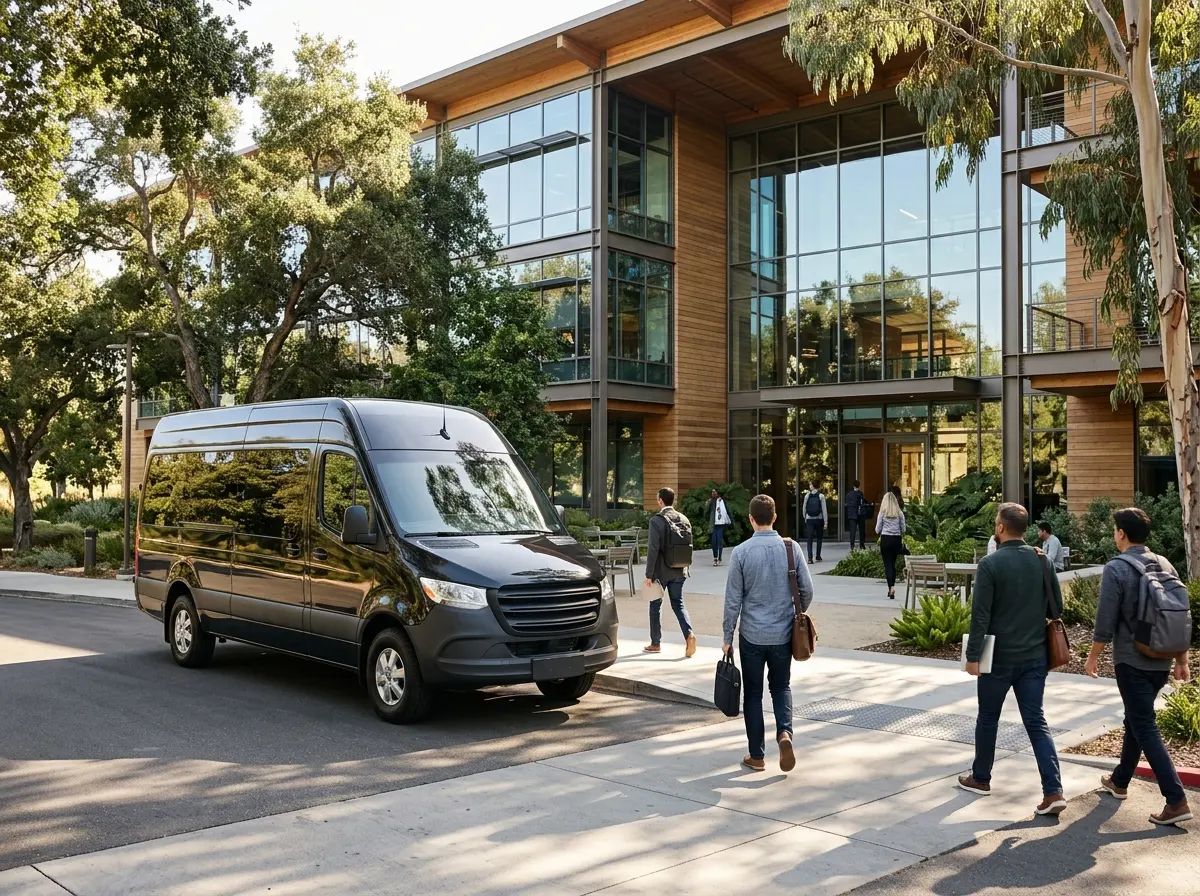 Illustrative image
Quick answer
Technology company transportation covers the ground moves a growing tech employer needs: commuter and campus shuttles, offsite and launch-event transfers, customer and investor visits, and executive travel. Corporate Travel USA designs these as programs from ridership and event data, coordinates them nationally through owned operations or vetted local partners confirmed per market, and prices each one by proposal.
The transportation problem
Technology Companies: the transportation challenge
Tech transportation problems come from growth rather than formality. A company with 80 people and one office becomes one with 800 across three cities, and nobody updated how people get to a customer event, an all-hands, or the airport. Rideshare receipts fill expense reports, nobody sees total spend, and no one owns the vendor relationship.
Many technology employers sit in places where commuting is hard: suburban campuses far from transit, or urban offices where parking is scarce. Shuttles from a rail station or a residential neighborhood are a real recruiting and retention tool, and they are a recurring contract rather than a one-off booking. They need route design, timing against office days and meeting culture, and a plan for the days attendance changes.
Event load is high and lumpy. A product launch, a developer conference, a customer summit or a company offsite needs dozens or hundreds moved in a short window, often with visiting executives and press arriving at the same time. Because teams are distributed, group airport arrivals for an offsite are a frequent source of difficulty. We scope these as separate programs, each with its own owner on your side.
Technology Companies: typical use cases
Campus and transit shuttles
Scheduled loops between transit stations, parking areas and offices, sized to arrival patterns rather than headcount alone.
Company offsites
Airport arrivals, hotel-to-venue shuttles and evening activity transportation for distributed teams gathering in one place.
Product launches and developer events
Guest, speaker and press movement between airport, hotel and venue across a short window.
Customer and investor visits
Hosted itineraries for prospective customers and investors touring an HQ, briefing center or lab.
Executive and founder travel
Recurring transfers for leaders who travel between offices, with options for a dedicated driver.
Candidate interview days
Airport and hotel pickups for senior candidates flying in for onsite interviews, coded to recruiting.
Booking and procurement for technology companies
The vehicle is the easy part. These are the operational details that decide whether the program runs on time.
- 01
Ridership data before route design
Badge data, commute surveys and office-day patterns tell us far more than a headcount does. Share what you have.
- 02
Self-serve booking needs
Teams often want employees or assistants to book directly. We scope request channels and approvals as program options rather than assuming a portal.
- 03
Budget ownership
Decide whether spend sits with facilities, people operations, events or a central travel team before the contract is written.
- 04
Flexible scale
Hiring waves change demand. Discuss how a shuttle program is adjusted when a floor opens or a team moves.
- 05
Accessibility and inclusion
Plan for wheelchair access, early and late schedules, and employees without other ways to get to work.
How do tech campuses run shuttles?
Tech campuses typically run shuttles as scheduled routes designed from badge and commute-survey data: a connector between a rail or transit station and campus, longer commuter routes from residential areas where commutes are hard, and a circulator where buildings or parking are spread out. Each route is timed to arrival peaks, not sized to headcount.
Headcount is a poor design input because people do not arrive evenly. Badge data usually shows sharp peaks after specific train arrivals and around the first meetings of the day, then a long quiet middle and a flatter evening peak. Hybrid schedules add a weekly pattern, with mid-week days far busier than Mondays and Fridays.
Illustrative: 150 riders arrive from one station between 8:30 and 9:30, and the round trip takes 20 minutes. A van of about 14 seats makes three trips an hour, roughly 42 seats, so covering the peak needs four vans or two minibuses of about 30 seats (roughly 180 seats an hour). If most riders come off two trains, larger vehicles timed to those trains beat a constant loop.
| Route type | What it solves | Typical vehicle | Key design input |
|---|---|---|---|
| Transit connector | Last mile from rail or transit to campus | Sprinter-class van or minibus | Train arrival times |
| Commuter route | Long commutes and scarce parking | Minibus or motorcoach | Anonymized home-area clusters |
| Campus circulator | Building-to-building and parking moves | Van or minibus | Meeting patterns and building count |
| Event-day overlay | All-hands, launches and visitor days | Motorcoaches | Attendance and start time |
Related:Employee shuttle programsShuttle program planning guideMinibuses
What rules and permits affect a tech shuttle?
Tech shuttles are shaped by three kinds of rules: local curb and permit programs where shuttles stop on public streets, federal driver-licensing thresholds tied to vehicle size, and tax and accessibility rules that the employer's own teams own. None is a reason not to run a shuttle, but each affects route design and cost.
Curb access comes first. San Francisco's SFMTA, for example, runs a Commuter Shuttle Program for employer-provided shuttles: permitted operators pay a per-stop fee and display placards in exchange for access to shared Muni zones and shuttle-only white zones. Other cities have their own rules or none, and a stop on private property needs the owner's permission.
Vehicle size drives licensing. Under the federal CDL rules in 49 CFR 383.5, a vehicle designed to transport 16 or more passengers including the driver is a commercial motor vehicle, so minibus and coach routes need CDL-qualified drivers. That affects driver availability, and therefore lead time, in each market.
Tax and accessibility belong to your HR, tax and legal teams. IRS Publication 15-B treats a ride in a commuter highway vehicle (one seating at least six adults besides the driver, with at least 80% of mileage expected for commuting and at least half the seats filled by employees) as a qualified transportation benefit, and lists a 2026 monthly exclusion of $340 for commuter highway vehicle transportation and transit passes. Separately, DOT's ADA transportation rules state that transportation an employer provides solely for its own employees is not subject to 49 CFR Part 37 (section 37.37(d)); the employer's own accessibility obligations still apply, so plan accessible options from the start.
Who should own transportation at a fast-growing tech company?
Transportation at a growing tech company works best with one accountable owner per program and one vendor agreement across them: workplace or facilities for shuttles, events or people teams for offsites and all-hands, executive operations for leadership travel, and recruiting for candidate visits. Spend then shows up in one place instead of in a hundred expense reports.
The usual starting point is sprawl. Each team books its own coaches for its own offsite, assistants each have a favorite local car service, candidates take rideshare and expense it, and finance sees transportation only as scattered line items. Nobody can say what the company spends on ground transportation, or whether every vendor meets the same safety and insurance standard.
A consolidated program can bring these under one master agreement with separate cost codes, request channels and approval rules per team. Those are options Corporate Travel USA scopes in a proposal, not a portal you are forced into.
| Program | Typical owner | Reporting that helps |
|---|---|---|
| Commuter and campus shuttles | Workplace or facilities | Ridership by route and hour |
| Offsites and all-hands | Events or people operations | Cost per attendee per event |
| Customer and investor visits | Sales or marketing operations | Trips by account or deal |
| Executive travel | Executive office or chief of staff | Trips by executive |
| Candidate interviews | Recruiting | Trips by open role |
Related:Enterprise ground transportationCorporate billing and invoicing
How should a tech company plan transportation for an offsite or product launch?
Plan offsite and launch transportation from the arrival manifest backward: group flights into arrival waves, size vehicles to each wave, and keep a separate, higher-touch plan for executives, speakers, press and customers whose timing cannot slip.
Distributed teams make this harder than it looks. Two hundred people flying from twenty cities do not arrive together, and sizing transfers to total headcount leaves coaches idle at noon and people waiting at 6 p.m. Product launches add a second audience, guests and press, whose arrival must be invisible and on time while employees ride shared shuttles.
Illustrative: 220 employees land at one airport between 10:00 and 18:00. Grouped into 90-minute waves, the manifest might show peaks of 60 to 70 people around midday and early evening with quiet stretches between, which points to a coach for each peak wave and vans for the gaps rather than coaches on standby all day. What to send in an offsite or launch request:
- Dates, venue and hotels, with addresses
- Expected headcount and arrival airports
- Flight manifest cut-off date and who sends updates
- Run-of-show times for sessions, dinners and activities
- VIP, speaker and press list with their separate needs
- Accessibility needs and the billing code
Related:Corporate retreat transportationGroup airport transfersGroup airport transfer planning
How do tech companies handle customer visits and briefing days?
Customer visits and executive briefing days work best as hosted itineraries: a named driver, a pickup at the customer's hotel or airport, a timed arrival at the briefing center, and a car that waits for lunch, a lab or data center tour, or dinner, all coded to the account so sales operations can see the cost.
The details that go wrong are small and visible. A visitor badge that was not pre-registered, so the customer waits in a lobby. A driver sent to headquarters when the briefing is at the demo center across town. A dinner that runs late with no car arranged back to the hotel. Each is avoided by an itinerary shared with the driver in advance and a host who can change it.
The same model serves investor visits and senior candidates flying in for interviews, where the arrival experience is part of the pitch. Drivers do not enter secure or restricted areas; they work to the pickup and drop points your security team sets.
Related:Client and guest transportationExecutive chauffeur service
Vehicle categories
Vehicles tech teams typically use
Categories, not guarantees. Availability varies by market and is confirmed in your proposal.
Executive Sprinter Vans
Typically 9-14 passengers depending on configuration
Chauffeured Sprinter-class vans that keep a mid-size team together on airport runs, offsites and meeting days.
Minibuses
Roughly 20-35 passengers depending on vehicle type and layout
Chauffeured minibuses for groups of roughly 20-35: conference loops, offsites, employee routes and airport groups.
Motorcoaches
Roughly 47-56 passengers per full-size coach
Chauffeured charter buses for large groups, conventions, offsites and multi-city movements, quoted per itinerary.
Executive SUVs
Typically 1-6 passengers depending on SUV class and luggage
Chauffeured business SUVs for small teams, extra luggage and travelers who want more space.
How a technology transportation program is set up
- 1
Assess demand
We review commute, event and executive travel patterns and who owns each.
- 2
Design the program
Routes, schedules, booking channels and reporting are proposed.
- 3
Pilot where possible
A shuttle route or event can be scoped as a defined trial before commitment.
- 4
Adjust with growth
We review ridership and event demand regularly and adjust the plan.
Procurement and reporting for tech companies
- Vendor onboarding and insurance certificates on request
- Billing split by team, office or cost center, scoped in the proposal
- Purchase order references carried to invoices
- Ridership and usage reporting as an option, with data handling agreed in advance
Technology company transportation FAQs
Can you run a shuttle between a transit station and our office?
We can propose one, designed from your arrival data. Vehicle type and frequency depend on demand, and operations in your market are confirmed at proposal stage.
Can employees book their own rides?
That is a program option we scope with you. The booking channel and approval rules depend on how your team wants to control spend.
Do you handle large offsites with dozens of arrivals?
Yes, we plan group airport arrivals and venue shuttles from the flight manifest. Coverage in the destination city is confirmed in the proposal.
How is spend reported across teams?
Reporting by team, office or cost center can be scoped into the program. The format is agreed before launch.
How is technology company transportation priced?
By proposal, built from cost drivers rather than a rate card: the number and size of vehicles at peak, service hours per day, days per year, the distance from the operator's base to the first stop, driver licensing needs and the market. We do not publish rates.
Can a shuttle start as a pilot?
Yes. A single route or a defined period can be scoped as a pilot, with ridership measured before the program expands. Pilot terms are set in the proposal.
What data do you need to design a shuttle?
Arrival data by hour from badges or a survey, anonymized home-area clusters such as ZIP codes, office days, transit timetables and parking constraints. Individual home addresses are not needed at the design stage.
Sources and references
- Commuter Shuttle Program, San Francisco Municipal Transportation Agency (SFMTA)
- Publication 15-B (2026), Employer's Tax Guide to Fringe Benefits, Internal Revenue Service
- 49 CFR 37.37, Other applications (ADA transportation rules), Electronic Code of Federal Regulations (eCFR)
- 49 CFR 383.5, Definitions (commercial driver's license standards), Electronic Code of Federal Regulations (eCFR)
Next step
Discuss a corporate account
A short qualification so the right person can prepare a consultation or proposal.
We do not publish a response-time promise until it is operationally confirmed. Time-sensitive request? Say so in the notes.
Start your request
Related programs for technology companies
- Employee Shuttle ProgramsScheduled employee shuttle service between offices, campuses and transit points, with routes and timetables designed around measured ridership.
- Corporate Retreat TransportationTransportation to and around remote retreat sites: staged arrivals, activity moves and group departures.
- Corporate Event TransportationPlanned ground transportation for corporate events: routes, loading zones, manifests and a dispatcher on the day.
- Group Airport TransfersArrival-wave management for groups: flight tracking, staging, meet-and-greet and timed departures to the venue.
- Resources employee shuttle program planning