Events and groups
Group transportation services sized to your real headcount
When dozens or hundreds of people must move at once, the vehicle count is only the start. We plan the waves, the loading points and the reserve that keep a large group moving on time.
Updated
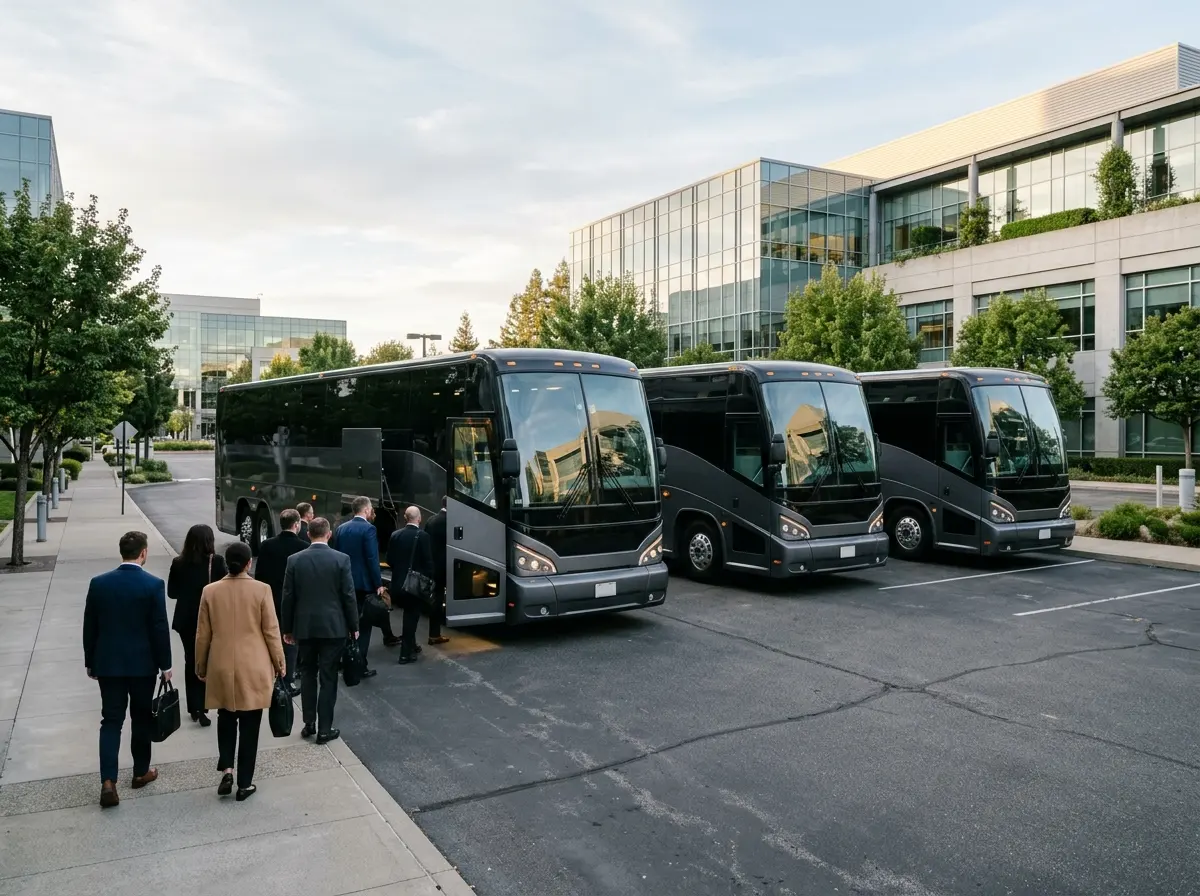 Illustrative image
Quick answer
Group transportation services move dozens or hundreds of people together on a schedule, using motorcoaches, minibuses and vans with professional drivers. They suit company meetings, incentive trips, training days and offsites. Corporate Travel USA plans the vehicle mix, departure waves and reserve, coordinates delivery through owned operations or qualified local partners confirmed per market, and prices every program by proposal.
How it works
How group transportation services work
Large groups behave differently from individual travelers. They arrive together, they board slowly, and one late person can hold a full motorcoach. A group of 200 does not need 200 seats of capacity in one vehicle type. It needs a considered split between large vehicles for volume and smaller ones for flexibility.
We start with three numbers: how many people, in what time window, and between which points. From those we work out how many vehicle cycles each point can support. Load time matters as much as drive time. A motorcoach that takes twelve minutes to load on a narrow curb effectively moves fewer people per hour than the same vehicle at a dedicated bay.
Group moves also carry duty of care. A manifest tells the dispatcher who should be on which vehicle and who is missing. For corporate groups this is not a courtesy; it is how you know everyone reached the venue. We build the manifest process into the plan and agree how late additions are handled.
Group transportation planning assistant
Enter your headcount and constraints for an indicative vehicle mix. This is a planning aid only: final vehicle allocation requires an operational review of the route, venue access, timing and local availability.
Indicative mix per wave
3 vehicles per wave, about 60 planning seats for 60 passengers. Real programs usually add spare capacity and staging time; we size that in the proposal.
Group transportation services: where they fit
Company-wide offsites and all-hands
Employees from several offices converge at one venue. Large vehicles move the bulk and a small van pool handles early and late movers.
Incentive and recognition trips
Groups of 40 to 300 move between airport, hotel and activities across several days. Fleet is held on a day-by-day plan.
Merger integration and training days
Hundreds of people travel between sites on a single day. Waves keep the destination entrance from being overwhelmed.
Association and member events
Mixed attendee types arrive over multiple days. Group blocks run on schedule, with on-demand vehicles for outliers.
Shift-adjacent mass moves
Large teams are moved for site visits, plant tours or relocations. For repeating workforce moves, see our workforce transportation program.
What we plan for in group transportation services
The vehicle is the easy part. These are the operational details that decide whether the program runs on time.
- 01
Wave design
We split one large movement into several departures so loading, road traffic and arrival areas are not overwhelmed. Wave size is set by the smallest bottleneck, usually the loading point.
- 02
Load and unload time
A full-size motorcoach commonly needs ten to fifteen minutes to load fully. We plan the headway between departures around real boarding time, not drive time alone.
- 03
Spare capacity
Large moves usually carry a reserve vehicle for every cluster of several routes. The right reserve depends on what a delay costs you, and we state our assumption in the proposal.
- 04
Manifests and marshals
Each vehicle gets a manifest and, where the program warrants it, a marshal with a count of boarded passengers. We agree who is responsible for headcount at each point.
- 05
Mixed-mobility needs
We ask early about wheelchair-accessible requirements and lift-equipped vehicles, as they have to be sourced specifically for the date and market.
Large group transportation: how many buses do you need?
To calculate how many buses you need, divide the number of people moving in one wave by a realistic planning load per vehicle, round up, then check whether each vehicle can make more than one trip in the time available. Add a reserve sized to what a delay would cost.
Planning load is lower than seat count. A full-size motorcoach typically seats 47 to 56, but planning at roughly 40 to 50 leaves room for carry-on bags, groups that want to sit together and the last few people who board slowly. With checked luggage, plan lower still unless the coach has under-floor bays sized for a full load.
Illustrative example (planning arithmetic, not a quote): 300 employees travel from a hotel to an offsite venue 25 minutes away. At 46 per coach that is 7 coach loads, because 300 divided by 46 is 6.5, rounded up. A round trip with loading and unloading takes about 65 to 70 minutes. If departures must all leave within 45 minutes, each coach makes one trip: 7 coaches plus a reserve, and the hotel must load 7 coaches in 45 minutes, which at about 15 minutes per departure means three loading bays.
Spread departures over about 100 minutes instead and roughly 4 coaches, most running twice, cover the same 7 loads, provided the hotel curb can load two coaches at once. Same group, same venue, four coaches instead of seven: the time window is usually the biggest lever on cost.
- Loads = people in the wave divided by planning load per vehicle, rounded up
- Trips per vehicle = departure window divided by round-trip time (including loading and unloading), rounded down, minimum 1
- Vehicles = loads divided by trips per vehicle, rounded up, plus a reserve
- Curb check: departures per bay per hour is roughly 60 divided by (load time plus pull-in and pull-out time)
Related:MotorcoachesCorporate event transportationGroup airport planning
Motorcoach charter, minibus or vans: which fits your group?
A motorcoach charter fits when 40 or more people travel together between the same two points and both ends have room to load a large vehicle. Minibuses fit groups of roughly 20 to 35 or venues a full coach cannot reach, and sprinter-class vans fit small groups, executives and flexible catch-up runs.
Fewer, larger vehicles usually cost less per seat, but the cheapest mix on paper can be the slowest on the day. A motorcoach that takes 12 minutes to load at a narrow curb moves fewer people per hour than two minibuses loading at separate doors, and one breakdown strands more people. When the venue makes the choice close, the proposal compares at least two mixes side by side.
Luggage often decides it. Full-size coaches are over-the-road buses, which FMCSA describes as having an elevated passenger deck over a baggage compartment, so they usually carry checked bags for a full load. Minibuses and vans lose seats to suitcases.
| Vehicle | Typical seated capacity | Best fit | Watch-outs |
|---|---|---|---|
| Full-size motorcoach | 47 to 56 | High-volume moves between two points, long drives, checked luggage | Needs long curb space and turning room |
| Minibus | Roughly 20 to 35, by layout | Mid-size groups, hotel loops, tighter venue access | Luggage space often limited |
| Sprinter-class van | 9 to 14, by configuration | Small groups, VIPs, catch-up and reserve runs | Low capacity per driver; luggage reduces seats |
| Executive SUV or sedan | 1 to 6 | Principals, speakers and late individual moves | Not a volume tool |
How much does a corporate charter bus cost?
A corporate charter bus is priced on the time the vehicle and driver are committed to your group, not just the miles your group rides. Corporate Travel USA does not publish rates; each quote is built from the movement plan, so two programs with the same headcount can price very differently.
To compare quotes fairly, send every provider the same brief: dates, headcount by movement, addresses, time windows, luggage, accessibility needs and how firm each number is. Ask each for the operating carrier's USDOT number too, so you can check its authority, safety rating and insurance in FMCSA's Bus Safety Search.
- Vehicle class and count, including any reserve held on standby
- Hours committed: operators commonly bill from when the vehicle leaves its base until it returns, often with a minimum booking period
- Driver count: a long day may need a second driver, because passenger-carrying drivers may drive at most 10 hours after 8 consecutive hours off duty and may not drive after 15 hours on duty
- Positioning: a vehicle sourced from outside the city adds time before your trip starts
- Overnight trips: driver lodging when the vehicle stays with the group
- Dates: peak weekends and citywide events tighten local supply
- Site costs: parking, tolls and venue or airport access fees where they apply
- Gratuity, waiting and change terms, stated in writing
Can you rent a bus without a driver?
No. Corporate Travel USA provides vehicles with professional drivers only. A vehicle designed to carry 16 or more passengers, counting the driver, is a commercial motor vehicle that requires a commercial driver's license, and the passenger endorsement on that license requires additional knowledge and skills tests, according to FMCSA.
Licensing is only part of it. A professional operator carries the insurance, vehicle maintenance, drug and alcohol testing and hours-of-service compliance that a self-drive arrangement would shift onto your company. For an employer moving its own staff, that is a duty-of-care question as much as a legal one. If you need vehicles employees drive themselves, that is a rental-car or fleet question outside our scope.
If the reason for asking is cost or flexibility, there are usually better levers: a smaller chauffeured vehicle, a van with a professional driver held on standby for ad hoc runs, or fewer, better-timed departures. Each can be priced side by side in a proposal.
Keeping a large group accounted for: manifests, marshals and accessible vehicles
A large group stays accounted for when every departure has a manifest, every loading point has someone counting, and accessible vehicles are booked before the schedule is final. Those three habits answer the question an employer is asked after any group move: did everyone arrive?
Manifests list who should board each departure. Marshals count heads at boarding and report the count to the dispatcher before the door closes; the dispatcher compares it with the manifest and starts the agreed catch-up rule for anyone missing. Everyone involved knows the rule in advance, so nobody improvises at the curb.
Illustrative catch-up rule: anyone missing at departure time gets one call from the marshal; if they are not at the curb within five minutes, the vehicle leaves on time and the person joins the next wave or the reserve van, and the dispatcher records where they went.
For accessibility, ask early. Under DOT ADA rules as summarized by FMCSA, charter motorcoach operators may require 48 hours' advance notice to provide transportation to passengers with disabilities, and lift boarding adds minutes that the wave timing must absorb.
| Group size (single wave) | Indicative primary vehicles | Indicative reserve |
|---|---|---|
| Up to 14 | 1 sprinter-class van | 1 sedan or van on call |
| About 50 | 1 full-size motorcoach | 1 van on call |
| About 120 | 2 to 3 motorcoaches | 1 motorcoach or 2 vans |
| About 300 | 6 motorcoaches in two waves | 1 to 2 motorcoaches plus vans |
Vehicle categories
Vehicles for group transportation services
Categories, not guarantees. Availability varies by market and is confirmed in your proposal.
Executive Sprinter Vans
Typically 9-14 passengers depending on configuration
Chauffeured Sprinter-class vans that keep a mid-size team together on airport runs, offsites and meeting days.
Luxury Sprinter Vans
Typically 9-14 passengers depending on configuration; premium layouts often seat fewer
A premium, chauffeured Sprinter-class category for executive groups, VIP delegations and client-facing movements.
Minibuses
Roughly 20-35 passengers depending on vehicle type and layout
Chauffeured minibuses for groups of roughly 20-35: conference loops, offsites, employee routes and airport groups.
Motorcoaches
Roughly 47-56 passengers per full-size coach
Chauffeured charter buses for large groups, conventions, offsites and multi-city movements, quoted per itinerary.
How we plan group transportation services, step by step
- 1
Count and window
We gather headcount, time window and endpoints, and ask which parts of the number are firm and which are estimates.
- 2
Mix and waves
A planner proposes vehicle mix, wave timing and reserve, and flags loading constraints at each point.
- 3
Manifest and brief
Manifests are issued to the dispatcher and, if used, to marshals. Drivers receive route and venue briefings.
- 4
Dispatch and adjust
A dispatcher tracks departures against plan, redeploys the reserve and keeps your on-site lead informed.
Group transportation services: procurement and billing
- Pricing by proposal, based on vehicle count, hours and distance
- A single invoice can be structured by event or cost centre; format is agreed in the proposal
- Insurance certificates available on request
- Cancellation and change terms are stated in the proposal, not assumed
Group transportation services FAQs
How many people can one motorcoach carry?
A full-size motorcoach typically seats 47 to 56 depending on configuration. We plan with a margin below the maximum so luggage, accessibility and late boarding do not break the schedule.
How do you calculate how many buses you need?
Divide the people in each wave by a realistic planning load, often 40 to 50 per full-size coach and lower with checked bags, and round up. Then see how many round trips fit in the departure window, add a reserve, and check that the loading curb can dispatch that many vehicles in time.
How much does a charter bus cost for a corporate group?
It depends on the hours the vehicle and driver are committed, vehicle class, driver count, distance, dates and site fees. We price by proposal and do not publish rates. A quote built on the same brief is the only fair comparison between providers.
Is it cheaper to use fewer, larger vehicles?
Often per seat, yes, but not always overall. Large vehicles can lose time at tight loading points, and a single breakdown affects more people. We compare mixes in the proposal.
How do you handle people who miss a wave?
We keep a small reserve and a defined catch-up route, usually a van or sedan from the same dispatcher. The rule for who qualifies for catch-up is agreed beforehand.
Do we need a separate luggage vehicle?
Sometimes. Full-size coaches typically have under-floor bays that carry checked bags for a full load, subject to the vehicle, but minibuses and vans lose seats to luggage. For airport moves with checked bags, a luggage van or a lower planning load per vehicle is often cheaper than a missed departure.
Can you move a large group across several cities?
We coordinate across US markets, with each market's supply confirmed at proposal stage. Multi-city programs need more lead time.
Sources and references
- Commercial Driver's License: Drivers, Federal Motor Carrier Safety Administration (FMCSA)
- Summary of Hours of Service Regulations, Federal Motor Carrier Safety Administration (FMCSA)
- Accessibility for Buses: Americans with Disabilities Act (ADA) Regulations and Rights, Federal Motor Carrier Safety Administration (FMCSA)
- Look Before You Book: Put Bus Safety First, Federal Motor Carrier Safety Administration (FMCSA)
Next step
Request an event transportation proposal
Tell us about the event, the movements and the passenger count. We will reply with a proposal for review.
We do not publish a response-time promise until it is operationally confirmed. Time-sensitive request? Say so in the notes.
Start your request
More like group transportation services
- Corporate Event TransportationPlanned ground transportation for corporate events: routes, loading zones, manifests and a dispatcher on the day.
- Group Airport TransfersArrival-wave management for groups: flight tracking, staging, meet-and-greet and timed departures to the venue.
- Convention Shuttle ServicesContinuous shuttle loops between hotel blocks and the convention venue, planned by headway and dwell time.
- Fleet motorcoaches
- Fleet minibuses
- Get a quote