Short answer
An employee shuttle program is a scheduled, employer-funded service that moves staff between transit hubs, parking and the workplace. To start one, name the problem it solves, survey demand, design routes around shift times, size vehicles for the peak arrival window and pilot one route for 8 to 12 weeks. Corporate Travel USA scopes corporate shuttle programs with professional drivers, vehicles confirmed per market and pricing by proposal.
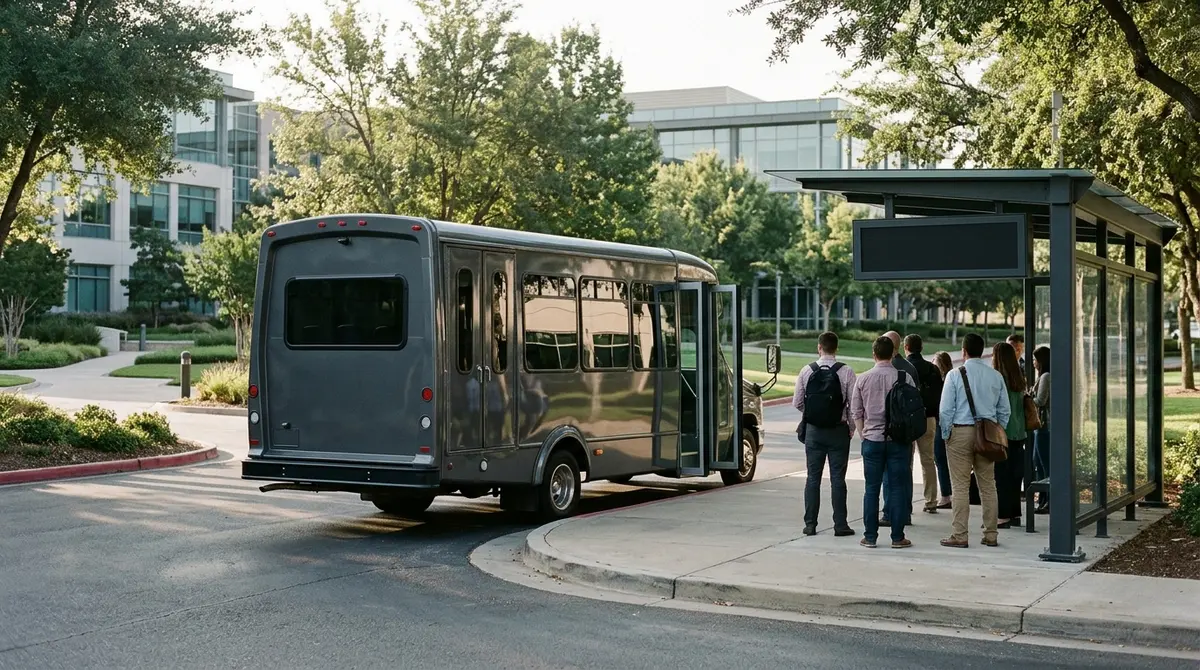 Illustrative image
How do you start an employee shuttle program?
Start an employee shuttle program in six steps: define the problem it solves, measure demand, design routes and schedules, size the vehicles, settle budget, tax and rider rules, and run a pilot before committing. Skipping the demand step is the most common reason shuttles run half empty.
- 1. Purpose: the one problem the shuttle must solve, plus any secondary goals
- 2. Demand: survey and map where riders start and when they need to arrive
- 3. Route and schedule: stops and departures built around shift times
- 4. Vehicles: type and count from the peak arrival window
- 5. Budget and rules: cost per ride, tax treatment, eligibility and a missed-ride policy
- 6. Pilot: one route for 8 to 12 weeks, measured and adjusted
What problem should a corporate shuttle solve?
A corporate shuttle should solve one named problem, such as a gap between transit and the workplace, a parking shortage, safe travel on late shifts, a link between two sites, or disruption during construction. Each problem leads to a different design, so name the main one before drawing a route.
Decide how you will know it works before launch. Measures you can actually collect are boardings per departure, the share of eligible employees riding, on-time arrival against shift start, and complaints about waiting. Set targets once you have a baseline, not before.
- Transit gap (first and last mile): a short, frequent loop timed to train or bus arrivals
- Parking shortage: remote lot to campus, high frequency around shift change
- Late or early shifts: fewer departures at fixed times, with a firm missed-ride policy
- Site-to-site link: point-to-point, on the hour or matched to meeting patterns
- Temporary disruption: a fixed end date, a simple route and clear communication
How do you measure shuttle demand before drawing routes?
Measure demand with a short employee survey and a map, then discount the answers, because stated intent overstates real use. Ask for home area by ZIP code or neighborhood rather than street address, shift times, current commute mode and how likely the person is to ride.
Illustrative arithmetic: if 400 employees say they would probably use a shuttle and you assume one in three actually will, plan around about 133 riders, not 400. Choose the discount deliberately and revisit it after the pilot.
Map the answers. Clusters of riders near a feasible stop make a route viable. A thinly scattered population usually means a shuttle is the wrong tool, and transit passes, vanpools or a managed rideshare allowance will serve people better.
How do you design shuttle routes and schedules?
Design routes from shift times outward: departures should deliver riders 10 to 20 minutes before shift start and leave 10 to 20 minutes after shift end. Keep routes short, because every added stop costs time for everyone already on board.
Choose between a hub-and-spoke model, with one pickup point near transit or parking, and a fixed route with several stops. Hubs are simpler to run and easier to keep on time; fixed routes reach more people but need more vehicles. Drive the route at the real times of day before committing.
- Hub-and-spoke: one or two pickup points, the most reliable timing, riders make their own way to the hub
- Fixed route: several stops, wider reach, longer ride times and more vehicles
- Plan for the busiest day of the week, not the average
- Provide a loading area at the workplace that does not block traffic
- Publish a policy for riders who miss the last departure
How many vehicles does a shuttle route need?
Divide peak riders by the seats each vehicle can deliver within the arrival window: vehicles = peak riders / (seats x round trips in the window), rounded up. Then add a margin for absences, breakdowns and peak days.
Illustrative arithmetic: 120 employees must arrive within a 30-minute window and a round trip takes 40 minutes, so each vehicle makes one trip in the window. Minibuses seating about 30 need 120 / 30 = 4 vehicles. Motorcoaches seating about 50 need 120 / 50 = 2.4, so three. Compare the two on total cost and on whether the workplace can load three coaches at once.
Vehicle size also determines who may drive it. Under federal rules, a vehicle designed to transport 16 or more passengers including the driver is a commercial motor vehicle for licensing purposes (49 CFR 383.5), and operating a passenger vehicle of that kind requires a commercial driver's license with a passenger endorsement (49 CFR 383.93). Corporate Travel USA provides shuttle vehicles with professional drivers; the capacities here are typical industry ranges, and the vehicles available are confirmed per market.
What does an employee shuttle program cost to run?
An employee shuttle program's cost is driven by vehicle hours, not riders: a vehicle running all day costs much the same whether it carries 5 people or 30. The useful comparison is cost per ride, which is the monthly cost divided by monthly boardings.
Illustrative arithmetic: one vehicle running 8 hours a day for 22 working days is 176 vehicle hours a month, while two peak-only blocks of 3 hours a day would be 132. Ask for pricing on both patterns, then compare each cost per ride with transit subsidies, parking costs and the cost of late arrivals. Prices come from a proposal for your route; none are published here.
Check the tax treatment with your tax adviser before launch. IRS Publication 15-B (2026) defines a commuter highway vehicle as one that seats at least six adults besides the driver, where at least 80 percent of mileage is expected to be home-to-work commuting with employees filling at least half the seats. For 2026 it sets a combined monthly exclusion of $340 for commuter highway vehicle transportation and transit passes, and it states that employers cannot deduct qualified transportation benefits, and cannot deduct the cost of transportation between an employee's home and workplace except as necessary for ensuring the employee's safety.
Weigh the other side honestly too: recruitment and retention at hard-to-reach sites, lower parking demand and fewer late arrivals. These are hard to value precisely, so describe them rather than forcing a number.
Do accessibility rules apply to a corporate shuttle?
Yes, but usually through employment law rather than transportation rules. DOT's ADA transportation rules state that transportation an employer provides solely for its own employees is not subject to 49 CFR Part 37; it falls under the EEOC's regulations under Title I of the ADA instead (49 CFR 37.37).
In practice, build accessibility in from the start: ask in the survey whether riders need an accessible vehicle or another accommodation, and request an accessible vehicle option in the proposal. If the shuttle will also carry visitors, customers or the public, different Part 37 rules may apply, so confirm the classification with counsel.
How do you run and measure a shuttle pilot?
Run one route for 8 to 12 weeks, count boardings by departure, survey riders at the midpoint and adjust times before scaling. Expect the first schedule to be wrong in at least one respect.
Review the data with the transportation provider on a fixed cadence, monthly during the pilot. Cut underused departures, add peak ones and revise stops. A shuttle is a living service, not a one-time installation.
- Boardings per departure and per day of the week
- Departures below an agreed ridership threshold, as candidates to cut
- Peak departures that leave riders behind, as candidates to add
- On-time arrival against shift start
- Rider feedback on stops, times and the missed-ride policy