Solutions
Long distance car service between cities, planned door to door
For routes where a flight adds little or does not exist, we coordinate chauffeured travel directly between cities. The vehicle is a working space, and the schedule follows the meetings.
Updated
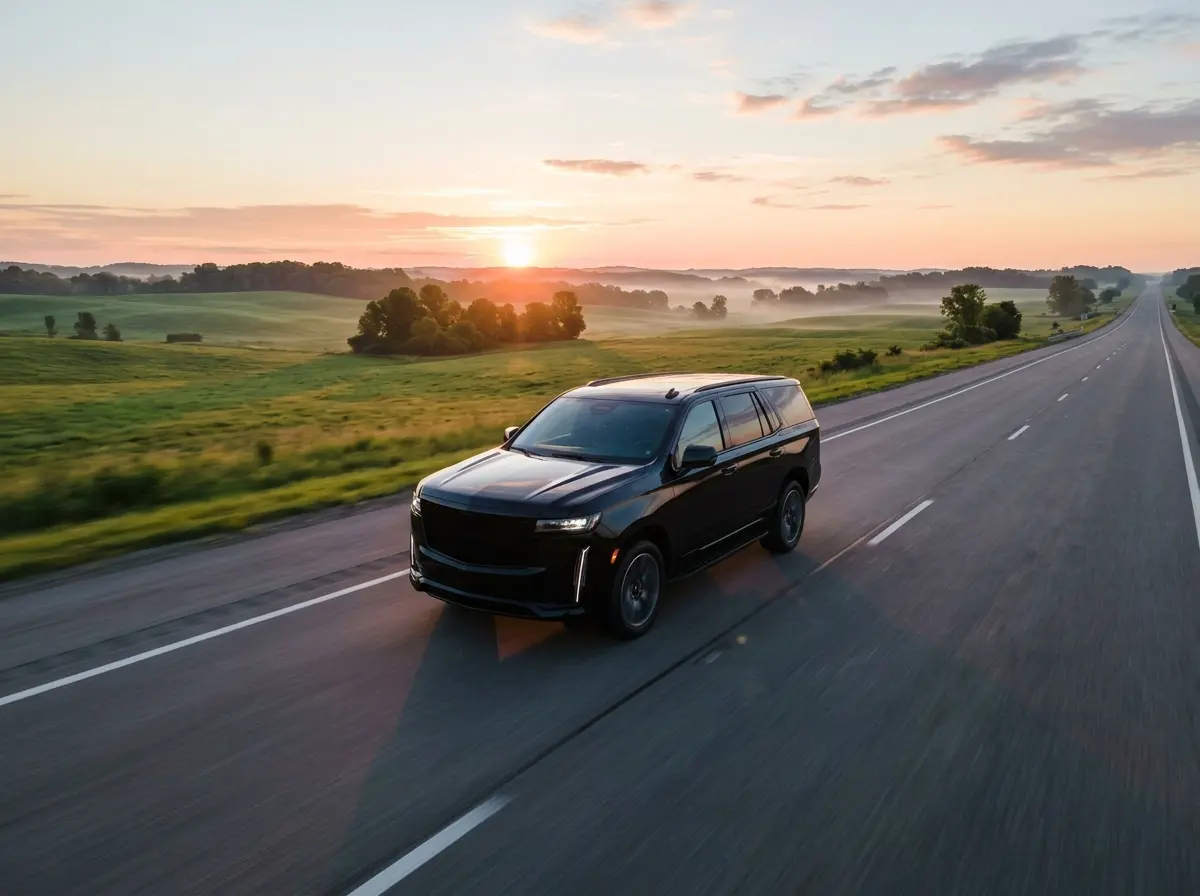 Illustrative image
Quick answer
A long distance car service is a chauffeured, door-to-door trip between cities, used when driving is quicker or more practical than flying once airport time is counted, or when a team wants to work on the way. Corporate Travel USA plans each route around distance, driver-hour limits and the return, using owned operations or vetted local partners confirmed per route. Pricing is by proposal.
How it works
How city to city car service works
Between nearby city pairs, flying is often slower than driving once the airport trips, security and delays are included. For these corridors, and for small teams that want to work or talk privately on the way, a chauffeured vehicle can be the better option.
Long distance trips are planned by route, not by hour. Distance, expected drive time, driver hours, rest stops and the return arrangement all affect how the booking is structured. A long one-way trip may need the driver to return empty, and the proposal shows that rather than hiding it.
Service is delivered by owned operations or qualified local partners, confirmed at proposal stage. For longer routes the operator at the origin may not be the right choice for the whole trip, and we say so in the proposal.
This is distinct from roadshows, which chain meetings across several cities, and from airport transfers, which move people to and from flights.
Long distance car service: where it fits
Short-haul corridors
Teams travelling between cities close enough that driving avoids airport time, and where the schedule allows it.
Working journeys
Executives and small teams who want to use the travel time for calls, preparation or a private conversation.
Areas with limited flights
Routes where flight options are infrequent, poorly timed or missing altogether.
Equipment-heavy trips
Teams carrying presentation or demonstration gear that is awkward on commercial flights.
Disruption backup
A road alternative when flights are cancelled and a meeting still has to happen.
What we plan for in long distance car service
The vehicle is the easy part. These are the operational details that decide whether the program runs on time.
- 01
Distance and driver hours
Longer routes can exceed the hours one driver can safely, and in some vehicles legally, drive in a day. We confirm how the operator manages this for your route.
- 02
One-way and round trips
Whether the vehicle waits, returns or repositions changes the structure. State the return plan when you request.
- 03
Weather and season
Mountain passes and winter weather affect timing and vehicle choice. Build in margin for these corridors.
- 04
Vehicle comfort
Longer trips favour SUVs and Sprinter-class vans for space. A sedan suits one or two passengers on a shorter route.
- 05
Working in transit
If the group needs to take calls or hold a meeting, say so, so we choose a vehicle and seating layout to match.
When is driving better than flying between cities?
Driving is usually the better choice when the door-to-door drive time is close to, or less than, the total for flying: getting to the airport, arriving early for security and boarding, the flight itself, getting off and out of the arrival airport, and the ride to the meeting. For city pairs a few hours apart that often favors the car, especially for a small group traveling together.
The time comparison is only part of it. In a car the group can work, take calls and talk privately for the whole journey, carry equipment without baggage rules, and leave when the meeting ends rather than when the next flight goes. Flying wins on long distances, on routes with frequent nonstop service, and when one traveler is going alone and can work at the gate.
The comparison below is illustrative only. Replace the assumptions with your own route, airports and company buffer policy before deciding.
- Drive when the door-to-door times are close, the group is two or more, or equipment is awkward to fly with.
- Fly when the drive is long enough to need an overnight or a second driver and a good nonstop exists.
- Consider driving one way and flying back when only one direction has a good flight time.
| Step | Flying | Driving |
|---|---|---|
| Office to departure airport | 40 min | Not needed |
| Arrive before departure | 90 min | Not needed |
| Flight or drive | 60 min | About 3 hr at highway speeds |
| Off the plane and out of the airport | 20 min | Not needed |
| Arrival airport to meeting | 40 min | Not needed |
| Rest stop | Not needed | 15 min |
| Door to door | About 4 hr 10 min | About 3 hr 15 min |
How is long distance car service priced?
Long distance car service is priced by the structure of the trip, not by distance alone: the total hours the vehicle and driver are committed, including the return or repositioning, plus the vehicle class, tolls, any overnight stay for the driver and any waiting at the destination. Corporate Travel USA quotes each route by proposal and does not publish per-mile rates.
The return plan usually matters more than the mileage. A one-way trip still commits the driver to the drive home, often called deadhead time. A same-day round trip adds the waiting time at the destination. A trip over several days adds either the driver's overnight costs or a second set of drives.
Illustrative example, hours only: a 200-mile route of about 3.5 hours each way. One-way with an empty return commits the driver for around 7 to 8 hours including breaks, although the passengers ride for 3.5. A same-day round trip with a 4-hour meeting commits around 11 to 12 hours. That is why two requests for the same distance can be priced very differently.
| Structure | What is committed | Fits when |
|---|---|---|
| One-way, empty return | The outbound drive plus the driver's return | Nobody needs to come back the same way |
| Same-day round trip | Both drives plus waiting at the destination | A meeting of a few hours, then home |
| Round trip with overnight | Both drives plus driver lodging and rest | A meeting spread over two days |
| Two separate one-way trips | Two drive-and-return cycles on different days | A long stay where holding the driver costs more |
How driver-hour limits shape an intercity car service trip
Driver-hour limits decide whether a long day needs a second driver, a relief swap or an overnight stop. For interstate trips in vehicles designed or used to carry more than 8 passengers, including the driver, for compensation, FMCSA rules limit driving to 10 hours after 8 consecutive hours off duty and bar driving after 15 hours on duty.
Sedans and SUVs carrying a few passengers fall below that federal passenger threshold, but fatigue does not. Corporate Travel USA plans long days conservatively for every vehicle class and confirms each operator's own driver-hour policy and any state rules for the route.
Illustrative example: a team leaves at 6:00 for a 5-hour drive, holds a 6-hour meeting and wants to drive home the same evening. With pre-trip checks from about 5:30, the driver's day ends around 22:30, roughly 17 hours. Unless the driver is genuinely off duty while waiting, that exceeds the 15-hour limit for a van covered by the federal rules. The realistic options are a second driver, a relief driver for the return, or an overnight stay.
- Tell us the latest acceptable arrival time, not just the departure.
- Expect planned rest stops on long drives, and build them into the schedule.
- For long same-day returns, ask for a second driver to be priced alongside an overnight.
Related:Transportation standardsHourly and dedicated chauffeurs
Chauffeured car, flight, train or self-drive: comparing intercity options
A chauffeured car gives the most usable working time and the most schedule control on short and medium routes; a flight wins on long distances; a train can be a strong option where a frequent service links both city centers; and self-drive often looks cheapest on paper but puts an employee behind the wheel after a full day of meetings. The right answer depends on the route, the group size and what the travel time is worth.
For duty of care, the self-drive line deserves attention. An employee driving several hours home after a long day is a risk worth writing into your travel policy, and a chauffeured return or an overnight stay is the usual alternative.
| Factor | Chauffeured car | Flight | Train | Self-drive |
|---|---|---|---|---|
| Door to door | Yes | No, airports at both ends | Usually station to station | Yes |
| Working time | Whole journey, privately | Limited and interrupted | Good, in a shared space | None for the driver |
| Group of four or more | One vehicle | A ticket per person | A ticket per person | One vehicle |
| Equipment and luggage | Flexible | Airline rules apply | Carried by the travelers | Flexible |
| Driver fatigue risk | Planned by the operator | Not applicable | Not applicable | On the employee |
Related:Transportation duty of care
What to include in a long distance trip request
Send the route, the time window and the return plan together: origin and destination addresses, the earliest departure and latest acceptable arrival, whether the car waits, returns or comes back another day, and the passengers, luggage and equipment. With those details Corporate Travel USA can structure the trip correctly the first time and flag where a flight would serve better.
- Origin and destination addresses, plus any stops on the way
- Earliest departure and latest acceptable arrival
- Return plan: same day, another day, or one-way only
- Passenger count, luggage and any equipment with rough dimensions
- Working needs, such as space to hold a meeting or take calls
- Billing reference and the person who approves changes
Related:Corporate roadshowsGet a quote
Vehicle categories
Vehicles for long distance car service
Categories, not guarantees. Availability varies by market and is confirmed in your proposal.
Executive SUVs
Typically 1-6 passengers depending on SUV class and luggage
Chauffeured business SUVs for small teams, extra luggage and travelers who want more space.
Luxury SUVs
Typically 1-6 passengers depending on SUV class and luggage
A premium, chauffeured SUV category for VIP guests, delegations and executives who need space and presentation.
Executive Sprinter Vans
Typically 9-14 passengers depending on configuration
Chauffeured Sprinter-class vans that keep a mid-size team together on airport runs, offsites and meeting days.
Luxury Sprinter Vans
Typically 9-14 passengers depending on configuration; premium layouts often seat fewer
A premium, chauffeured Sprinter-class category for executive groups, VIP delegations and client-facing movements.
Executive Sedans
Typically 1-3 passengers
Chauffeured business-class sedans for individual executives and small teams on airport, meeting and city-to-city runs.
How a long distance car service engagement works
- 1
Send the route
Origin, destination, date, return plan, passenger count and luggage.
- 2
We assess the trip
We check drive time, driver hours, operator coverage and the best vehicle, and flag where a flight might serve better.
- 3
Proposal
You receive terms covering route structure, vehicle and any waiting or return conditions.
- 4
Travel and follow-up
The driver runs the trip to plan, and we remain reachable for delays or changes.
Long distance car service: procurement and billing
- Pricing is by proposal and reflects route structure rather than a fixed per-mile rate.
- Cost-centre and trip reference fields can be recorded per booking.
- Insurance certificates available on request for the assigned operator.
- Recurring corridors can be scoped as a program.
Long distance car service FAQs
How far can you drive?
There is no fixed cap. The practical limits are driver hours, operator coverage and whether the trip makes sense compared with flying. Very long routes usually need a second driver or an overnight, and we say so if flying would serve better.
Is it cheaper than flying?
It depends on the route and group size. We do not quote prices on the site, and the proposal gives you what you need to compare the options.
Can the driver stay for several days?
Yes, as a separate arrangement. For a driver assigned to one executive or team for a period, see hourly and dedicated chauffeur service.
Can we do the return on a different day?
Yes, but it changes the structure. State the plan upfront so the proposal reflects it.
Do you cover cross-state routes?
Yes, subject to operator authority and coverage, which we confirm at proposal stage. For interstate trips, FMCSA generally requires for-hire passenger carriers to hold operating authority in addition to a USDOT number.
Can the car stop on the way?
Yes. Planned stops, such as a second pickup, a site visit or a meal, should be in the request so the timing and driver hours account for them. Unplanned stops are usually possible but add time.
Is Wi-Fi available on long trips?
Some vehicles have Wi-Fi and power outlets, but it varies by operator and vehicle. If the group needs to work online, say so in the request and we confirm what the assigned vehicle has.
Sources and references
- Summary of Hours of Service Regulations, Federal Motor Carrier Safety Administration (FMCSA)
- 49 CFR 390.5, Definitions (commercial motor vehicle), eCFR, Office of the Federal Register
- Get Operating Authority (Docket Number), Federal Motor Carrier Safety Administration (FMCSA)
Next step
Get a quote for this trip
Share the itinerary and we will come back with a quote. Two short steps.
We do not publish a response-time promise until it is operationally confirmed. Time-sensitive request? Say so in the notes.
Start your request
Related services and guides
- Corporate RoadshowsMulti-city ground transportation for roadshows, with a single plan and coordinated local operators in each stop.
- Executive Chauffeur ServiceProfessional chauffeured transportation for executives, coordinated nationwide and confirmed market by market at proposal stage.
- Hourly & Dedicated ChauffeurHourly chauffeur service: a car and driver held as directed for a day, or one dedicated chauffeur for a week of visits.
- Resources managing multi city business travel
- Company nationwide network
- Fleet executive sprinter vans