Solutions
Corporate car service for meetings, site visits and client days
We coordinate chauffeured cars for the working day: meetings away from the office, client sites, partner offices and dinners. The plan follows the agenda, including the part that overruns, and the billing follows your company's rules.
Updated
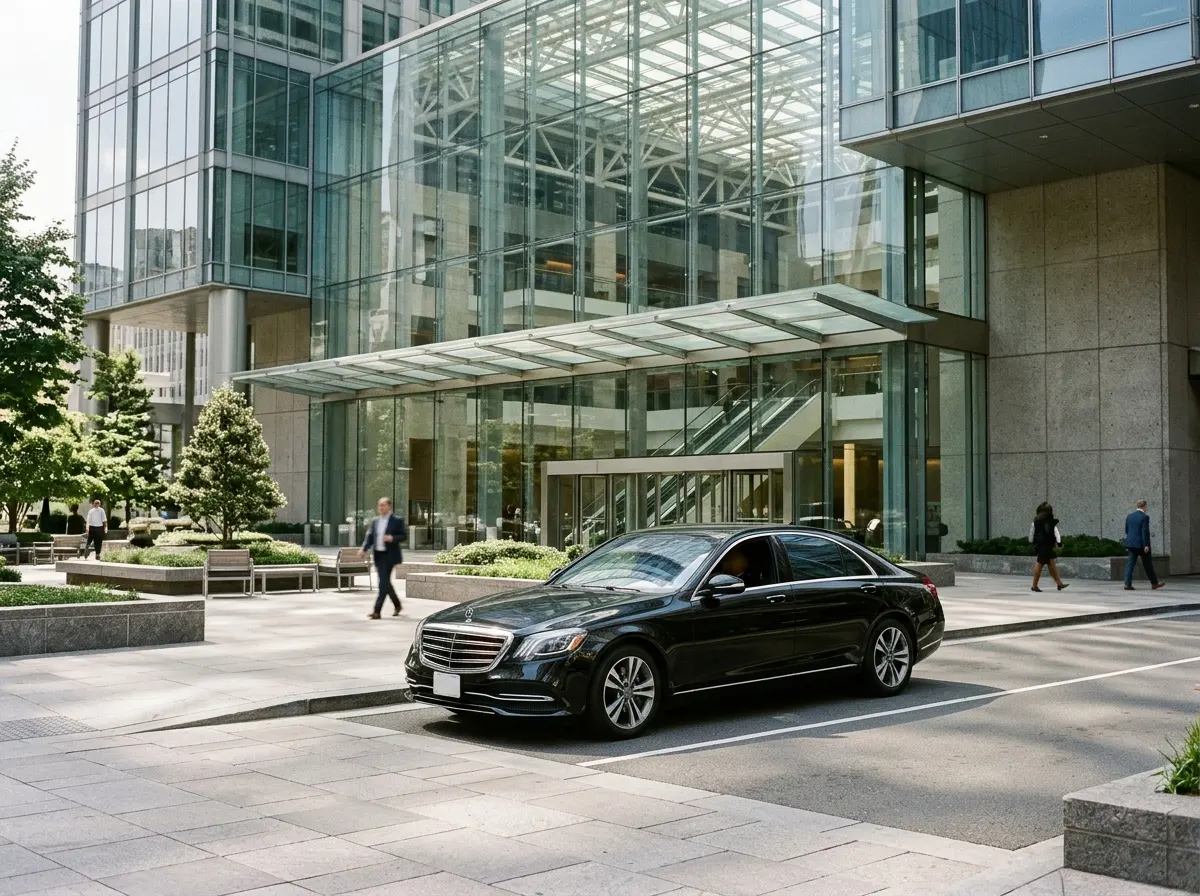 Illustrative image
Quick answer
A corporate car service is chauffeured transportation that a company books and pays for on account for its people and guests: meeting runs, site visits, client dinners and multi-stop business days. Corporate Travel USA coordinates it across the US through owned operations or vetted local partners confirmed per market, with bookers, approvers and billing references agreed up front. Pricing is by proposal.
How it works
How business meeting transportation works
A meeting has a start time and a fuzzy end time. That asymmetry is the main planning problem. Getting people there is easy to schedule; getting them out when the discussion runs long, or splitting up when half the group has to leave early, is what needs a plan.
A corporate car service is built around the agenda: who needs to arrive when, who leaves when, and what the vehicle does in between. For a short in-city meeting this may be a car held at the venue. For a day of meetings across several sites it may be a sequence of stops with one vehicle assigned for the day.
Service is delivered by owned operations or qualified local partners, confirmed at proposal stage. We ask about venue access, parking and drop-off rules early, because those details often decide whether the plan works. On the company side, we agree who can book, who approves and how each trip is referenced for billing, so the account works the same way in every city.
This page covers everyday business travel by car. Conferences and large events are covered in the events section, and service planned around one senior leader is covered under executive chauffeur service.
Corporate car service: where it fits
Off-site leadership meetings
A team gathering at a hotel or offsite venue, with a vehicle assigned for arrival, a mid-day run and return.
Client site visits
A group visiting a client facility, with transport to the site, waiting and return.
Multi-stop meeting days
A day with meetings at several locations, using one vehicle held between them.
Working lunches and dinners
A short run to a restaurant and back, with the driver waiting and the group returning together.
Negotiations and deal meetings
Transportation for sessions that may run late, with open-ended return arrangements agreed beforehand.
What we plan for in corporate car service
The vehicle is the easy part. These are the operational details that decide whether the program runs on time.
- 01
Open-ended returns
If the meeting could run long, plan the return as on-call rather than at a fixed time. Waiting time is typically charged and is covered in the proposal.
- 02
Venue access
Ask about drop-off zones, security checks, parking rules and loading areas at each venue. A driver who knows the entrance saves ten minutes.
- 03
Group size and seating
A group of five to eight often travels better together in one vehicle than in two cars. Bring the headcount to the planning.
- 04
Contact on the day
Choose a single contact at the venue and a single contact for the group, so the driver knows who to call.
- 05
Confidential conversation
If the group will talk inside the vehicle, tell us. Privacy expectations can be passed to the driver.
How do companies set up a corporate car service account?
A company sets up a corporate car service account by agreeing five things with the provider: who may book, who approves, which vehicle classes are allowed for which trips, how each booking is referenced for billing, and which vendor documents procurement needs. With Corporate Travel USA these are scoped in a proposal and confirmed before the first booking, so a trip booked in one city follows the same rules as a trip booked in another.
Insurance is usually the document that takes longest. For interstate trips, federal rules set the minimum public liability for for-hire passenger carriers at $1,500,000 for vehicles seating 15 passengers or fewer, including the driver, and $5,000,000 for vehicles seating 16 or more (49 CFR 387.33). These are federal minimums, and your risk team may require more, so state the limits you need in the request and certificates can be checked against them before the account goes live. A carrier's registration and safety record can also be checked on FMCSA's SAFER Company Snapshot.
Keep the booking rules short enough that people follow them. A policy nobody reads gets bypassed the first time someone is in a hurry.
- Bookers: the assistants, coordinators or travelers allowed to request trips
- Approvals: who signs off, and which trips need sign-off at all
- Vehicle policy: for example sedans by default, SUVs for groups or winter markets
- Billing references: PO, cost centre, project or matter code on every trip
- Invoicing: per trip or consolidated, as an option scoped in the proposal
- Vendor documents: tax forms, certificates of insurance and any security or data questionnaire
Related:Request a corporate accountBilling and invoicingRFP and procurement
How do you handle meetings that run late?
Plan the return as on-call rather than at a fixed time. The driver holds nearby, the group's contact messages when the meeting is wrapping up, and waiting time is charged on terms agreed in the proposal. For meetings that often overrun, holding the car is usually more reliable than rebooking a return at short notice.
There are four ways to structure the return, and the right one depends on how predictable the meeting is and how much a late car would cost the group. The trade-off is always the same: the certainty of a waiting car against paying for time it may spend idle.
Illustrative example: a negotiation is scheduled for 14:00 to 16:00 but could run to 19:00. A fixed 16:15 pickup is cheapest if it ends on time, but leaves the team rebooking on a busy evening if it does not. A car held on call from 16:00 costs waiting time, known in advance. A release-and-recall arrangement sits between the two, if the operator can commit to a recall window.
| Option | How it works | Best when |
|---|---|---|
| Fixed pickup | The car arrives at an agreed time | The meeting has a firm end time |
| On-call hold | The car waits nearby and leaves on a message | The end time is uncertain and lateness is costly |
| Release and recall | The car is released and called back within an agreed window | The meeting is long and the market has spare capacity |
| Split return | Two vehicles for early and late leavers | Part of the group has to leave on time |
Business car service for multi-stop meeting days
For a day of meetings at several sites, book one business car service vehicle for the day rather than separate rides: the stops are planned in order, the driver learns each entrance, and the car waits while the group is inside. It also removes the risk of a separate pickup failing between meetings.
Build the schedule door to door, not from drive time alone. Each stop adds time for the drop-off, building security, sign-in and the walk to the meeting room, and the same again on the way out. Venues with security desks, campus parking or shared loading areas usually take longer than the map suggests.
Illustrative example: four meetings across one metro. Five drives of 20 to 25 minutes come to about 1 hour 45 minutes. Adding 10 to 15 minutes at each end of every stop for access and exit adds roughly another 1 hour 40 minutes, so the day holds about three and a half hours of transit. Plan the agenda with that number, not the map's.
- Where can a car stop for drop-off and pickup, and for how long?
- Is there a security desk, visitor registration or ID check?
- Where can the driver wait: on-site parking, a nearby lot, or circling?
- Is there a separate entrance for visitors or after-hours access?
Which vehicle fits a meeting group?
Match the vehicle to the group that needs to arrive together: a sedan for one to three people, an SUV for up to about six depending on the class and luggage, a Sprinter-class van when the group outgrows an SUV, typically up to 14 depending on configuration, and a minibus beyond that. A group of five to eight often travels better in one van than in two cars, because everyone arrives at the same moment.
Two vehicles still make sense when the group will split: some leave early for a flight, or a host needs to stay behind with the client. Decide that before booking, because adding a second car on the day is harder than releasing one.
| Group | Typical fit | Why |
|---|---|---|
| 1-3 people | Sedan | Simplest to stage at most venues |
| 4-6 people | SUV, by class and luggage | One vehicle, one arrival |
| 7-14 people | Sprinter-class van | The group can talk on the way and arrive together |
| 15 or more | Minibus, or several vans | Check venue drop-off space for larger vehicles |
Related:Executive Sprinter vansMinibuses
Vehicle categories
Vehicles for corporate car service
Categories, not guarantees. Availability varies by market and is confirmed in your proposal.
Executive Sedans
Typically 1-3 passengers
Chauffeured business-class sedans for individual executives and small teams on airport, meeting and city-to-city runs.
Executive SUVs
Typically 1-6 passengers depending on SUV class and luggage
Chauffeured business SUVs for small teams, extra luggage and travelers who want more space.
Executive Sprinter Vans
Typically 9-14 passengers depending on configuration
Chauffeured Sprinter-class vans that keep a mid-size team together on airport runs, offsites and meeting days.
Minibuses
Roughly 20-35 passengers depending on vehicle type and layout
Chauffeured minibuses for groups of roughly 20-35: conference loops, offsites, employee routes and airport groups.
How a corporate car service engagement works
- 1
Share the agenda
Locations, times, headcount and which parts could run over. For an ongoing account, add who books and how trips are referenced.
- 2
We check venues and coverage
We confirm the operator and look at access rules at each venue.
- 3
Proposal
You receive terms for vehicle, waiting arrangements and return structure, plus account rules where relevant.
- 4
Run the day
The driver follows the agenda and we handle changes while you focus on the meeting.
Corporate car service: procurement and billing
- Pricing is by proposal and depends on hours and waiting needs.
- Meeting, project or matter codes can be attached to each booking.
- Consolidated invoicing for repeat meeting programs can be scoped.
- Insurance certificates available on request.
Corporate car service FAQs
Can the vehicle wait through the meeting?
Yes, as a waiting or hourly arrangement. The terms are explained in the proposal so there is no surprise on the invoice.
What if the meeting ends early?
Tell the contact on the day. The driver is released or redeployed according to the operator's policy, which we describe in the proposal.
Is this the same as corporate event transportation?
No. This covers everyday business travel by car and agenda-led meetings. Events with many attendees and multiple vehicles are handled under corporate event transportation.
Can you coordinate several meetings in a week?
Yes. For a regular pattern of meetings, we can scope a recurring program such as monthly corporate transportation.
Can we rent a car without a driver?
No. Corporate Travel USA provides vehicles with professional drivers only. The driver is part of the service: routing, parking, venue access and waiting are handled for you, and the operator holds the licensing and insurance for carrying passengers. For self-drive, use your company's rental car program.
Can one account cover several cities?
Yes. The account rules, references and approvers stay the same, while the operator in each city is confirmed at proposal stage. Coverage is confirmed per market and per date.
Who can book on a corporate account?
Whoever you authorise: typically executive assistants, office managers, travel coordinators or the travelers themselves. The list of bookers and approvers is agreed when the account is set up and can be updated as people change roles.
Sources and references
- 49 CFR 387.33, Financial responsibility, minimum levels, eCFR, Office of the Federal Register
- SAFER Web: Company Snapshot, Federal Motor Carrier Safety Administration (FMCSA)
Next step
Discuss a corporate account
A short qualification so the right person can prepare a consultation or proposal.
We do not publish a response-time promise until it is operationally confirmed. Time-sensitive request? Say so in the notes.
Start your request
Related services
- Executive Chauffeur ServiceProfessional chauffeured transportation for executives, coordinated nationwide and confirmed market by market at proposal stage.
- Client & Guest TransportationVIP transportation for the clients, candidates and visitors your company hosts, arranged in your name and billed to your account.
- Monthly Corporate TransportationRecurring ground transportation programs scoped to how your organization actually moves people, proposed for 30 days up to a year.
- Billing and InvoicingBilling structures for corporate programs, including consolidated invoicing, PO numbers and cost-centre coding as options scoped in a proposal.
- Corporate Event TransportationPlanned ground transportation for corporate events: routes, loading zones, manifests and a dispatcher on the day.
- Get a quote