Events and groups
Group airport transportation managed as arrival waves
Groups do not land at the same time, and trying to move everyone at once leaves vehicles idle or passengers waiting. We organize arrivals into waves and release vehicles as people are ready.
Updated
 Illustrative image
Quick answer
Group airport transportation moves event attendees and corporate groups between airports and hotels or venues by grouping flights into arrival waves, each with a sized vehicle, a staging point and a departure rule. Corporate Travel USA plans the waves and tracks flights, and coordinates delivery through owned operations or qualified local partners confirmed per market. Pricing is by proposal.
How it works
How group airport transportation works
The problem with group airport transfers is that arrivals are spread out and unpredictable. Fifty attendees may land across a dozen flights over six hours. If a motorcoach waits for everyone, early arrivals wait and late arrivals miss it. If every attendee has a sedan, cost is high and curb space is overwhelmed.
We handle this with arrival waves. Flights are grouped by landing time into windows, for example a 60 to 90 minute wave. Each wave gets a vehicle sized to the expected headcount in that window, a staging point, a meet-and-greet position and a rule for when the vehicle leaves. Passengers who arrive between waves are directed to a smaller on-call vehicle.
Flight tracking drives the dispatcher's decisions. A delayed flight might move someone from one wave to the next, or a cancelled flight might remove them from the manifest entirely. The manifest is a living document: who is on which flight, which wave, which vehicle and whether they have boarded. This is what lets you answer the question of where everyone is.
Group airport transportation: where it fits
Conference and event arrival days
Hundreds of attendees land from many origins. Waves and meet-and-greet staff keep curb traffic orderly.
Incentive groups arriving together
A group on a charter or shared flight needs a single large vehicle and coordinated luggage handling.
Departure-day airport runs
Event end triggers a surge of airport trips. We stagger vehicle departures by flight time.
Executive delegations
Smaller VIP groups arrive on private or commercial flights. See VIP delegation transportation for protocol and security planning.
Retreat and offsite arrivals
Arrivals spread over a day, with a long transfer to the venue. We pool where we can.
What we plan for in group airport transportation
The vehicle is the easy part. These are the operational details that decide whether the program runs on time.
- 01
Arrival manifest
We ask for each attendee's flight number, airline and terminal. Without this, wave planning is guesswork. Manifests update as travelers change flights.
- 02
Wave sizing
Wave windows balance wait time and vehicle fill. Shorter windows mean shorter waits but more vehicle trips and higher cost.
- 03
Meet-and-greet
Where a greeter is scoped, they hold a sign at a defined position and direct people to the staging area. Airport rules for greeters and vehicle waiting vary and are checked per airport.
- 04
Staging and curb rules
Airports restrict where commercial vehicles may stand. We confirm the staging lot and pickup curb for each terminal.
- 05
Luggage volume
Luggage can limit capacity more than seats. A van that seats 12 may carry far fewer people with full luggage, so we size on bags too.
How are arrival waves grouped for group airport transfers?
Arrival waves are grouped by scheduled landing time into windows, commonly 60 to 90 minutes long, and each wave gets a vehicle or set of vehicles sized to the people expected in that window. Shorter windows cut waiting but add vehicle trips; longer windows fill vehicles but make early arrivals wait.
Illustrative example (planning arithmetic, not a past program): 80 attendees land on 18 flights between 11:00 and 17:00 at one airport. Grouped into 90-minute windows, that is four waves, sized here with checked luggage, which lowers how many people each vehicle can carry.
Passengers who land between waves, or whose flights change, go to a smaller on-call vehicle rather than holding a full coach. Windows work best when counted from the time bags are likely to be collected, not from touchdown.
| Wave | Landing window | Expected arrivals | Indicative vehicles |
|---|---|---|---|
| 1 | 11:00 to 12:30 | 14 | 1 minibus |
| 2 | 12:30 to 14:00 | 31 | 1 full-size motorcoach |
| 3 | 14:00 to 15:30 | 23 | 1 minibus and 1 sprinter-class van |
| 4 | 15:30 to 17:00 | 12 | 1 minibus |
Related:Group airport planning guideCorporate airport transfers
What happens when flights in a group are delayed?
When a flight in a group is delayed, the dispatcher applies a rule agreed in advance: hold the wave vehicle up to a set limit, move the delayed passengers to the next wave, or send a smaller vehicle for them alone. The rule matters more than the tracking, because it decides who waits and what it costs.
Waiting time is a cost driver, so the proposal states how waiting is charged and when a vehicle is released. Attendees should receive one message with the pickup point and a number to call if their plans change.
- Small delay inside the wave's window: the vehicle holds, and others wait a known time
- Delay past the window: passengers move to the next wave, and the current wave leaves on time
- Cancelled or rebooked flight: the passenger is moved on the manifest and told where to go
- Last flight of the day running late: an on-call van or sedan waits, not the coach
Related:Group transportation servicesConference transportation
When is an airport shuttle for groups better than individual cars?
An airport shuttle for groups beats individual cars when several attendees land within the same window and travel to the same hotel or venue. It cuts curb traffic and cost per person and keeps the group on one manifest. Individual cars are better for executives, very spread-out arrivals and people with tight onward schedules.
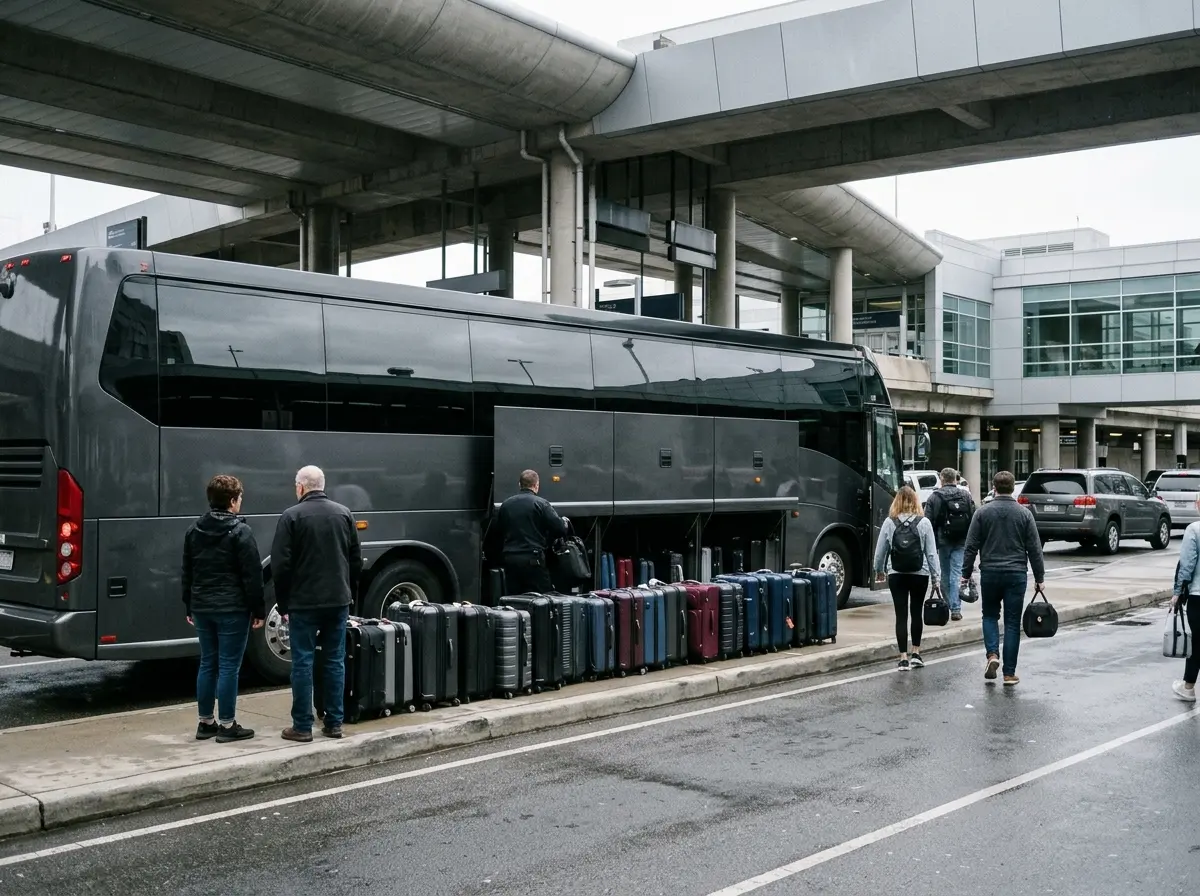
Luggage often limits a vehicle before seats do. A van that seats 12 may carry far fewer people with full checked bags. Full-size motorcoaches are over-the-road buses, which FMCSA describes as having an elevated passenger deck over a baggage compartment, so they usually handle checked bags for a full load; minibuses and vans often do not.
Airports set their own rules for commercial vehicles: where they may wait, which curb they use and whether a greeter may meet passengers inside the terminal. We confirm those rules for each airport and terminal before the schedule is final.
Related:MinibusesSprinter vans
Vehicle categories
Vehicles for group airport transportation
Categories, not guarantees. Availability varies by market and is confirmed in your proposal.
Executive Sedans
Typically 1-3 passengers
Chauffeured business-class sedans for individual executives and small teams on airport, meeting and city-to-city runs.
Executive SUVs
Typically 1-6 passengers depending on SUV class and luggage
Chauffeured business SUVs for small teams, extra luggage and travelers who want more space.
Executive Sprinter Vans
Typically 9-14 passengers depending on configuration
Chauffeured Sprinter-class vans that keep a mid-size team together on airport runs, offsites and meeting days.
Minibuses
Roughly 20-35 passengers depending on vehicle type and layout
Chauffeured minibuses for groups of roughly 20-35: conference loops, offsites, employee routes and airport groups.
Motorcoaches
Roughly 47-56 passengers per full-size coach
Chauffeured charter buses for large groups, conventions, offsites and multi-city movements, quoted per itinerary.
How a group airport transportation engagement works
- 1
Collect arrivals
You provide flight details by attendee or ask us to collect them through your registration process.
- 2
Build waves
We group flights into waves, size vehicles and set the rule for departure and overflow.
- 3
Confirm airport logistics
We confirm terminals, curb positions, staging lots and greeter arrangements.
- 4
Track and release
The dispatcher tracks flights, updates the manifest and releases vehicles on the wave plan.
Group airport transportation: procurement and billing
- Pricing by proposal; wave count and waiting time are the main cost drivers
- Flight-delay waiting terms are stated in the proposal
- Per-attendee reporting for cost allocation can be scoped as a program option
- Insurance certificates on request
Group airport transportation FAQs
What happens if a flight is delayed?
The dispatcher tracks the flight and either holds the vehicle or moves the passenger to the next wave. The waiting rule and any associated charges are set out in the proposal.
How long should an arrival wave be?
It is a trade-off. A 60 to 90 minute window is common, but the right figure depends on flight density and your tolerance for waiting. We compare options during planning.
What do you need from attendees?
Flight number, airline, arrival date and time, terminal if known, bag count and any mobility needs, plus a mobile number for day-of contact. Departure flights are collected the same way for the return.
How much does group airport transportation cost?
The main drivers are the number of waves, vehicle class per wave, waiting time, airport access fees where they apply and any greeters. Fewer, longer waves cost less but mean longer waits. We price by proposal.
Do you provide greeters?
A greeter or meet-and-greet service can be scoped for the program. Rules for where greeters may stand vary by airport.
Can we mix group vehicles and individual sedans?
Yes. Executives often take a sedan or SUV while the main group uses a van or coach. We run both from the same manifest.
Sources and references
- Accessibility for Buses: Americans with Disabilities Act (ADA) Regulations and Rights, Federal Motor Carrier Safety Administration (FMCSA)
Next step
Request an event transportation proposal
Tell us about the event, the movements and the passenger count. We will reply with a proposal for review.
We do not publish a response-time promise until it is operationally confirmed. Time-sensitive request? Say so in the notes.
Start your request
More like group airport transportation
- Corporate Airport TransfersAirport car service for business travelers: flight-tracked pickups, a clear meeting point at the terminal and a plan for delays.
- Large Group TransportationMoving a large group on a schedule: motorcoach and van mixes, wave planning and spare capacity.
- Conference TransportationHotel-to-venue shuttles, airport arrivals and session-driven peaks planned for multi-day conferences.
- VIP Delegation TransportationProtocol-aware transportation for executive delegations and visiting dignitaries, with discreet vehicles and security coordination.
- Resources group airport transfer planning
- Request a proposal